Thursday 11 June 26
Beyond Command and Control: Why the Future Belongs to Leaders Who Build Learning Organisations
By The Leadership Alchemist, a performance optimisation expert who believes in ethical intelligence, practical productivity, and the responsible acceleration of human potential.
For decades, leadership has been shaped by a powerful assumption: that success comes from having the answers.
Boards appoint leaders because of their expertise. Organisations reward decisiveness. Institutions often celebrate certainty. The prevailing image of leadership remains one of control, direction, and authority.
Yet the reality facing today's executives is fundamentally different.
The challenges confronting organisations are increasingly systemic, interconnected, and unpredictable. Geopolitical uncertainty, technological disruption, artificial intelligence, workforce transformation, public trust, regulatory complexity, cyber threats, and shifting stakeholder expectations are colliding in ways that no single leader, board, or executive team can fully anticipate.
In this environment, the greatest risk is not uncertainty itself. It is the belief that traditional approaches to leadership remain sufficient.
The Demise of the Heroic Leader
Across my work with senior leaders in government, defence, the public sector, and complex organisations, I continue to encounter a striking paradox. The institutions most often perceived as hierarchical and resistant to change are frequently among the most advanced in their understanding of complexity, adaptation, and organisational learning.
The reason is simple. When the stakes are high, leaders quickly discover that expertise alone is not enough.
Success depends upon the ability to learn faster than the challenges evolve.
The era of the heroic leader; the individual expected to possess all the answers, is giving way to a different model. Today's most effective leaders recognise that no single person can fully understand the complexity of modern organisational systems. Their role is not to know everything, but to create the conditions in which collective intelligence can emerge.
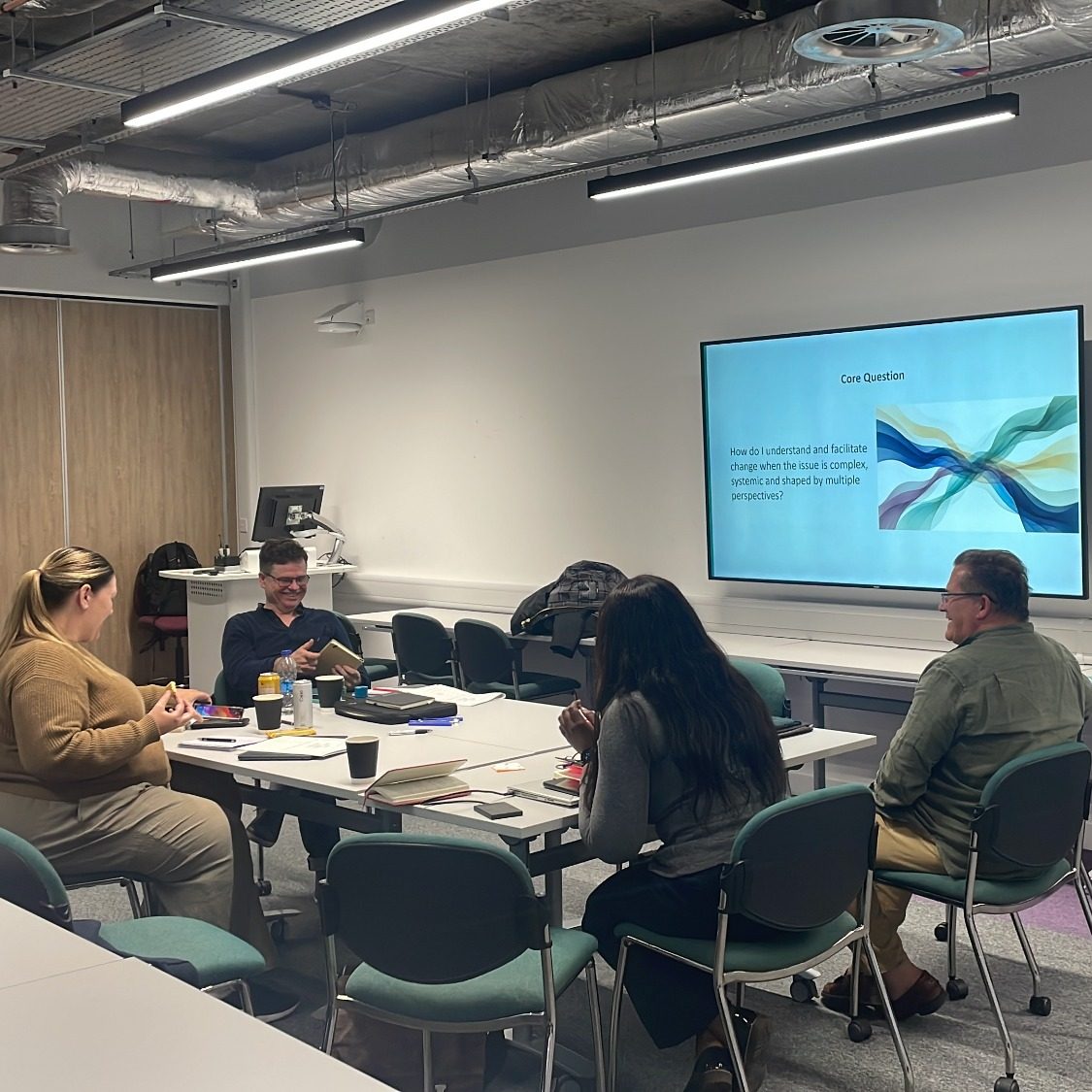
Action learning facilitation enables active questioning and working with not knowing, empowering colleagues to learn with and from each other through live business challenges.
The Leadership Challenge Behind Every Transformation
This insight sits at the heart of every significant transformation effort I have supported.
Whether guiding strategic decision-making through the Strategic Orbits Exercise®, facilitating action learning programmes, supporting organisational restructuring, or helping executive teams navigate AI-enabled transformation, the same lesson emerges repeatedly: Sustainable change is not primarily a technology challenge, a strategy challenge, or even a structural challenge. It is a leadership challenge. More specifically, it is a challenge of creating organisations capable of learning.
Transformation programmes often focus heavily on systems, processes, and implementation plans. Yet many fail because insufficient attention is paid to the human capability required to navigate uncertainty, challenge assumptions, and adapt when circumstances change.
Successful transformation is ultimately a function of organisational learning.
Why Learning Is Becoming a Strategic Capability
The most effective leaders I encounter are not distinguished by their ability to provide answers. They are distinguished by their ability to create environments where better questions can be asked.
They understand that in complex systems, certainty is often an illusion.
They recognise that the quality of decisions is directly linked to the quality of conversations taking place across the organisation.
They know that organisational resilience emerges not from rigid control, but from distributed capability, shared understanding, and collective intelligence.
This represents a profound shift in how we think about leadership.
The traditional model assumes that authority drives performance.
The emerging model recognises that learning drives performance.
Boards and executive teams are increasingly expected to make decisions in environments characterised by incomplete information, accelerating change, and competing priorities. Under these conditions, leadership becomes less about directing outcomes and more about creating the conditions in which organisations can adapt successfully.
Action Learning and the Power of Better Questions
This is why action learning has become increasingly relevant at the highest levels of leadership.
Action learning is often misunderstood as a development methodology. In reality, it is a strategic capability.
It enables leaders to challenge assumptions, reflect on experience, surface blind spots, and strengthen decision-making in real time. It creates disciplined opportunities for inquiry at precisely the moment organisations are tempted to rush toward premature conclusions.
For boards and executive teams, this discipline is increasingly valuable. The ability to pause long enough to ask better questions can often prove more valuable than the ability to produce faster answers.
In complex environments, the quality of inquiry frequently determines the quality of outcomes.
Strategy in an Age of Uncertainty
The same principles underpin the work we undertake through the Strategic Orbits Exercise®. When organisations face significant strategic choices, the objective is not simply to identify the right answer. It is to improve the quality of thinking that informs decision-making.
Leaders need opportunities to explore uncertainty, test assumptions, understand second and third-order consequences, and engage with complexity before committing to a course of action.
The organisations that thrive are rarely those that predict the future most accurately.
They are those that develop the capability to adapt most effectively.
As strategic horizons become less predictable, organisations must move beyond linear planning and embrace approaches that enable continuous learning, experimentation, and adaptation.
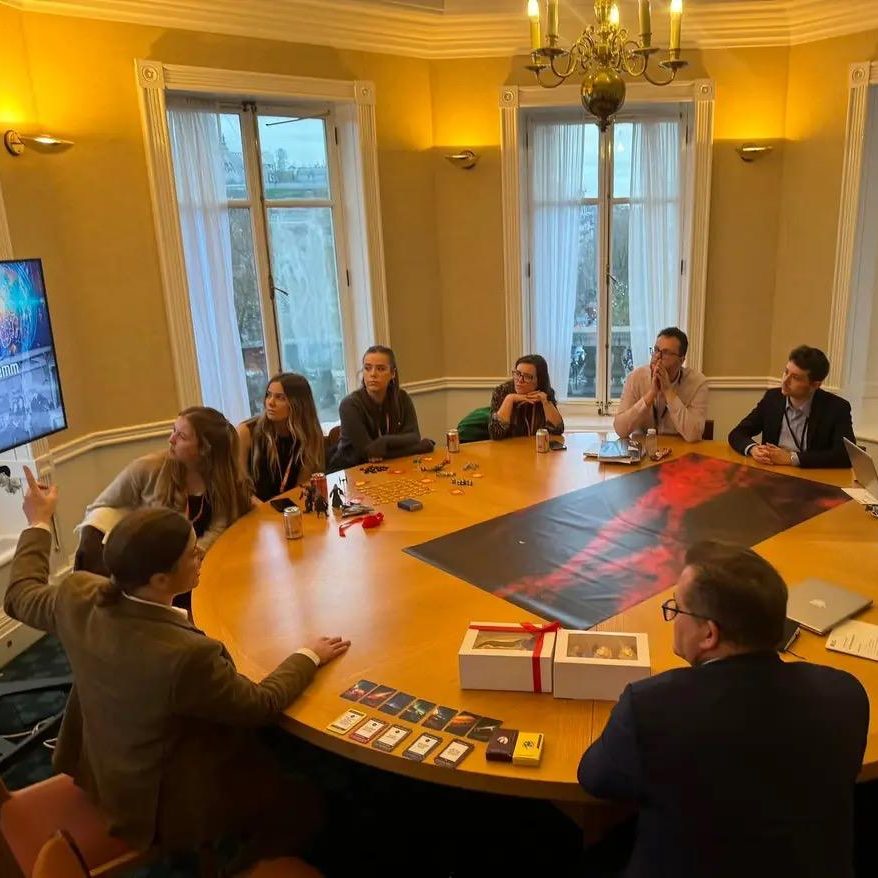
A Parliamentary team working with not knowing through the AI enabled Strategic Orbits Exercise®.
AI, Human Judgement and the Future of Leadership
This challenge becomes even more pressing as artificial intelligence reshapes the strategic landscape.
Much of the current conversation about AI focuses on technology adoption. Far less attention is paid to the leadership capabilities required to realise its potential.
The organisations seeing the greatest benefit from AI are not necessarily those with the most sophisticated technology. They are those capable of integrating technological capability with human judgement, systems thinking, collaboration, and learning.
AI can accelerate analysis. It cannot replace wisdom.
It can identify patterns. It cannot build trust.
It can generate options. It cannot determine purpose.
Those responsibilities remain firmly within the domain of leadership.
The future will not belong to organisations that simply deploy AI. It will belong to organisations that combine technological capability with human adaptability and strategic insight.
A Question for Boards and Executive Teams
For boards and executive teams, this raises an important question:
Are we investing as much in our organisation's capacity to learn as we are in its capacity to execute?
Because in an increasingly uncertain world, the competitive advantage that matters most may not be operational efficiency, technological capability, or even strategic positioning. It may be the ability of leaders, teams, and organisations to learn faster, adapt more effectively, and make sense of complexity together.
Learning capability is becoming a strategic asset.
Those organisations that cultivate it deliberately will be better positioned to respond to disruption, seize emerging opportunities, and sustain performance over time.
The New Responsibility of Leadership
The future belongs to organisations that can navigate transition at every level.
Leaders who can evolve their thinking.
Teams that can collaborate across boundaries.
Organisations that can adapt without losing coherence.
Boards that can govern uncertainty without demanding false certainty.
The challenge for today's leaders is not simply to manage change. It is to build institutions capable of learning their way through it.
That is the work of modern leadership.
And increasingly, it is the defining responsibility of every board and executive team seeking to remain relevant in a world that refuses to stand still.
Stay safe, and add value. \
The Leadership Alchemist