Thursday 19 March 26
Clarity Over Complexity: Leadership Lessons from a World in Flux
By The Leadership Alchemist, a performance optimisation expert who believes in ethical intelligence, practical productivity, and the responsible acceleration of human potential.
This week, leaders around the world are still grappling with a landscape defined by volatility, rapid technological change, and geopolitical escalation. From rising tensions in the Middle East driving sharp energy price spikes and market uncertainty, to heated political debates over UK domestic policy and digital regulation, the external environment continues to be a powerful reminder of how quickly complexity can overwhelm clear thinking if not managed deliberately.
In this context, the distinction between clarity and complexity is not academic; it is strategic. As someone who has spent years facilitating team development, coaching and mentoring for senior leaders, and designing gamified decision‑making exercises, I have seen first-hand how leaders can fall into the ‘decision trap’ of mistaking dense analysis for intelligent action. Yet those who stand out; whether in frontline operations, corporate boardrooms, government strategy sessions, or international forums, are the ones who cultivate clarity of thought and purpose.
This is my challenge to all decision-makers today: Complexity can obscure weak thinking, but clarity exposes it. It is not something you’re born with; it is something you build. And building it begins with self‑reflection, disciplined questioning, and repeated testing under pressure.
Leading with Clarity Through Better Questions
The Foundation: Action Learning Facilitator Accreditation (ALFA)
In my work as a coach and action learning facilitator, I often see highly competent senior teams default to answers too quickly when under pressure, especially when the stakes are high. Over the years, one pattern has stood out to me: C Suites and boards who ask better questions consistently produce clearer, more effective decisions.
That’s why we deliver the unique, business focused Action Learning Facilitator Accreditation (ALFA). Slowing down our thinking just enough to ask the right questions helps leaders strip problems back to their essence. Instead of adding complex frameworks and layers of data, we encourage our participants to identify what really matters, by reflecting on questions such as:
- What problem are we really solving?
- What assumptions are we making?
- What can we ignore?
- Who truly cares about this?
- What isn’t the problem?
A vivid example from my own practice occurred during a multi‑billion‑pound technology platform transformation with a global organisation. The senior team was stuck. Progress was blocked by an internal “veto club” of hidden powerbrokers who felt compelled to weigh in on every decision in a way that was both disempowering for the team and unseen by them. Complexity became a defence mechanism, a way of deflecting uncertainty rather than confronting it.
Through action learning, we encouraged the team to stop defending their expertise and start questioning the assumptions embedded in their approach. Once they began to ask why rather than what next? the paralysis dissolved. The “veto club” gave way to a focused set of priorities, and leaders immediately began making decisions and taking actions that aligned with strategic outcomes, not procedural correctness. That shift - a move from complexity to clarity - was transformative.
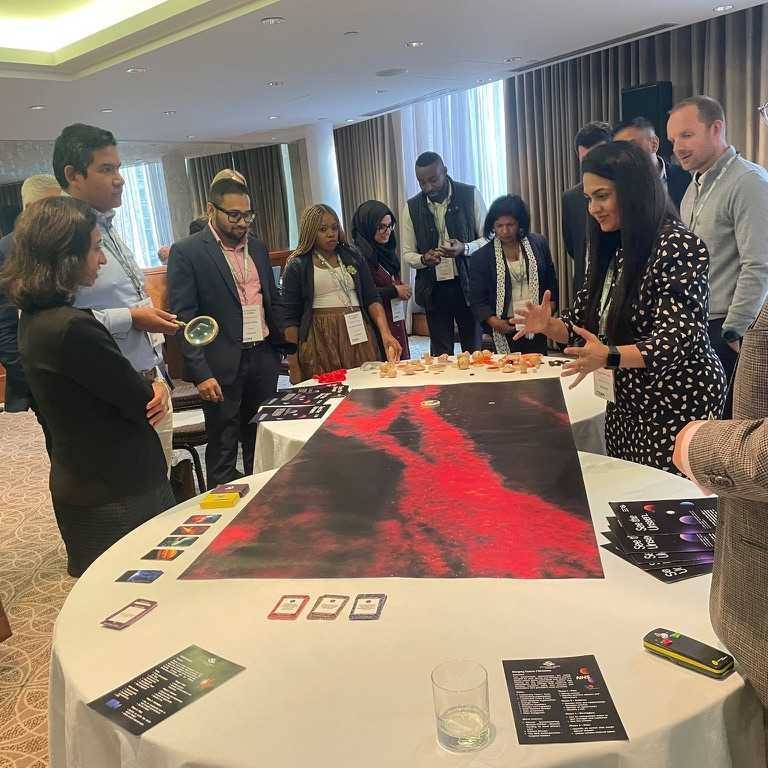
CIO, CFO and CISOs using the Strategic Orbits Exercise® to provide clarity through questions.
Acting with Clarity Under Pressure
The Test: Strategic Orbits Exercise®
Clarity in theory is powerful. Clarity under pressure is transformative. Over the years, I’ve designed and facilitated gamified decision‑making simulations that put leaders in high‑stakes scenarios, where ambiguity and time pressure force real ‘in the moment’ insights.
One exercise, built around national strategic planning, brought together policymakers and business leaders confronting cross‑sector challenges. An MP participating in the simulation spoke up: National strategies often fail because they become disconnected from local realities. Her reflection, balancing national vision with local implementation, cut through abstract debate and brought laser focus to what decisions actually mattered in the moment.
As global headlines remind us this week, the Middle East conflict is disrupting energy markets and amplifying geopolitical risk; leaders are being forced to clarify what decisions cannot wait, who owns critical actions, and how to align diverse stakeholders under pressure.
In one simulation with senior technology executives (CISOs, CTOs, and CIOs), overly complex risk frameworks were quickly exposed as decision‑making roadblocks. When confronted with simulated crisis conditions, leaders had to answer: What matters right now? What decisions cannot wait? Through repetition, the exercise forced prioritisation, clarified escalation paths, and made ownership unmistakable. These leaders left with practical adjustments they could implement immediately; not more reports, but clearer actions and a methodology that is universally relevant.

Business leaders using the Strategic Orbits Exercise® as a decision making tool.
A Reflective Practice for Today’s Leaders
In my dual roles as facilitator and thought partner, I’ve learned that clarity does not emerge without intention. It develops through:
- Reflection on Action – asking disciplined, reflective questions
- Reflection in Action – confronting ambiguity under pressure
This isn’t a one‑off exercise. It’s a decision-making muscle that must be strengthened constantly. In times like these, when markets react to geopolitical shocks, political debates amplify divisions, and technological change accelerates; the ability to think clearly is more valuable than ever. Leaders don’t need more strategy. They need clearer thinking, tested before it matters.
The difference between complexity and clarity isn’t merely theoretical, it’s tactical. And the leaders who master that difference will shape outcomes, not just respond to them.
Clarity isn’t optional in a complex world; clarity is the point......
Stay safe, and add value. \
The Leadership Alchemist