Friday 09th October 26
Decision Advantage: From Crisis to Corporate
Why the organisations that rehearse for uncertainty make better decisions when it matters
By The Leadership Alchemist, a performance optimisation expert who believes in ethical intelligence, practical productivity, and the responsible acceleration of human potential.
International uncertainty and instability are prevailing. Technology and capability investment is accelerating. AI is changing how organisations analyse information, anticipate markets and make decisions. New platforms, operating models and intelligent systems are being deployed at extraordinary speed.
But the leadership challenge of 2026 is not simply adopting new technology. It is enabling people to make good decisions under pressure, collaborate across organisational boundaries, challenge assumptions, work effectively with AI and translate new capability into operational performance. Because technology can accelerate a good decision. It can also accelerate a bad one.
And in an increasingly volatile world, the distance between a seemingly small decision and a major organisational consequence is getting shorter.
Small decisions. Big consequences.
For twenty years, my work has taken me into crisis management centres, disaster environments, headquarters of government organisations and corporate boardrooms. The environments have been different. The underlying leadership challenge has often been remarkably similar: How do you make a good decision when the information is incomplete, the clock is running, the consequences are uncertain and everyone in the room sees the problem differently? That is the environment in which decision advantage matters.
A technology investment that appears relatively contained can create dependencies that become difficult to unwind. A platform decision can reshape an operating model. A communications decision can change stakeholder or client behaviour. A procurement decision can create a vulnerability that remains invisible until the external environment changes.
A seemingly rational decision, made in isolation, can become something very different when combined with the decisions that follow.
This is why organisational or national resilience cannot simply be about preparing for the dramatic event. It has to include understanding how organisations make decisions before the event looks like a crisis.
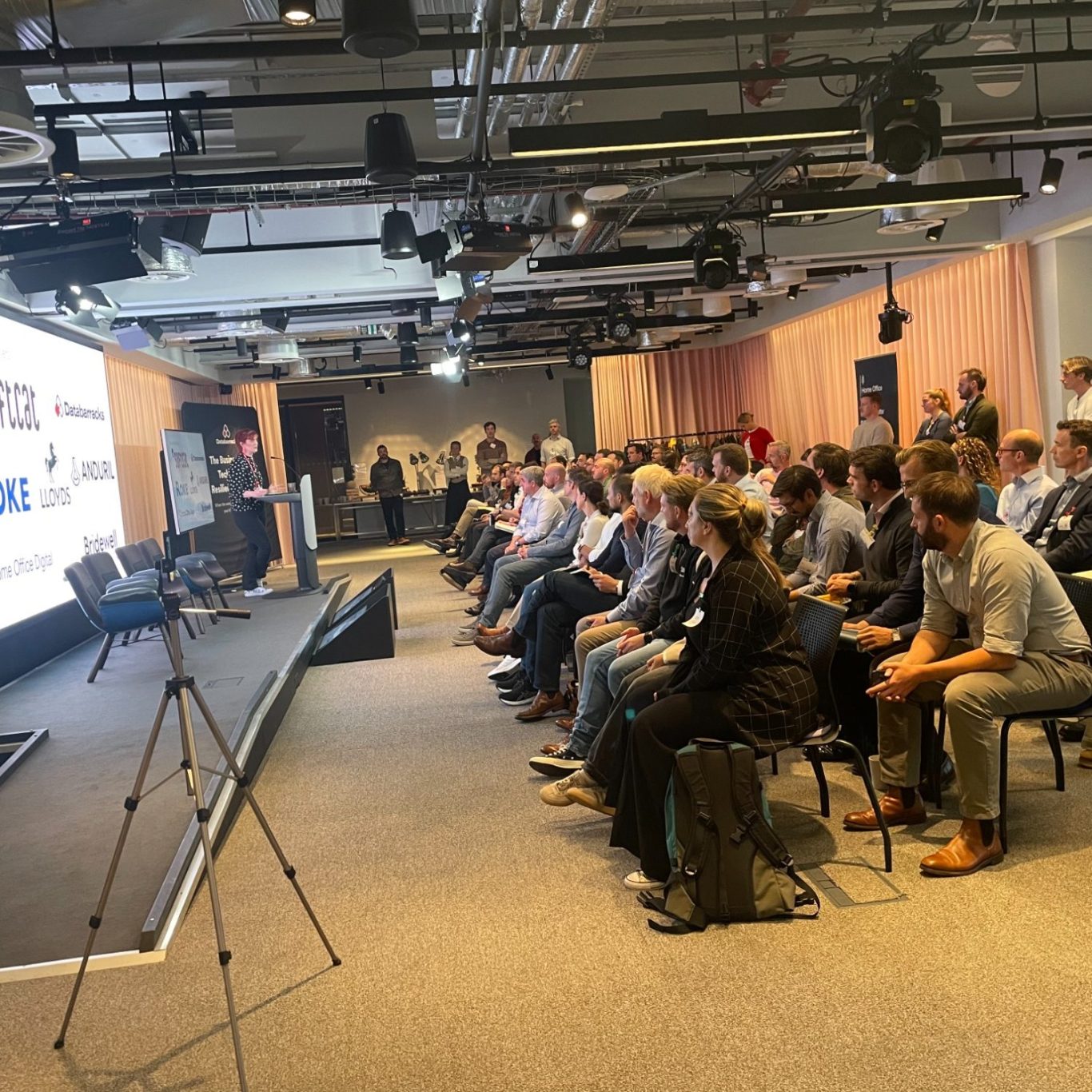
Supporting a recent TechVets event at Google headquarters in Kings Cross. Companies that are looking for enhanced foresight and crisis-informed leadership are increasingly seeking to hire Service Leavers and Veterans. Experience in frontier environments enables Service Leavers to act decisively and recognise systemic signs as situations change rapidly; skills that are scarce in today's talent market.
The danger is rarely that every decision is catastrophic. It is that a sequence of reasonable decisions can gradually narrow the organisation's options until the consequences become unavoidable.
The leadership opportunity is therefore to move further upstream. Don't just prepare for the crisis. Prepare the decision-makers before the crisis arrives.
What is Decision Advantage?
Decision advantage is not about making decisions quickly for the sake of speed. It is the ability to see further, understand faster and act with greater confidence when uncertainty is high. It brings together foresight, judgement and rehearsal.
Foresight helps us look beyond the immediate horizon, using data, intelligence, scenario thinking and horizon scanning to understand what could happen next. Judgement allows human beings to interpret that information, challenge assumptions, understand context and decide what matters. Rehearsal allows leaders to practise those decisions before the consequences become real.
Crisis is an extreme version of corporate life
One of the most important lessons from twenty years of crisis-informed foresight practice is that crisis does not create organisational behaviour. It reveals it.
Under pressure, organisations become less able to hide their underlying decision architecture. The quality of relationships becomes visible. Trust becomes visible. Leadership becomes visible. Information flows become visible. Bureaucracy becomes visible. And so do the people who can make sense of complexity and move others towards action.
I have repeatedly seen something fascinating in crisis environments: The person with the most authority is not always the person with the greatest leadership capacity. Crisis can strip away organisational architecture and reveal leadership talent in unexpected places. People who may be invisible in normal operating conditions can suddenly become essential. They see the problem. They connect people. They ask the question nobody else is asking. They make sense of ambiguity. They create momentum. And people follow them.
That observation has profound implications for corporate leadership. Because if you can identify and develop those capabilities before the crisis, you don't have to wait for the crisis to discover who your real leaders are.
Urgency changes behaviour
One of the most powerful effects of crisis is urgency. When the consequences of inaction become tangible, collaboration changes. People stop protecting territory. They share information. They find the person who can solve the problem. They escalate faster. They make decisions. They act.
A team that makes one good decision quickly is more likely to approach the next decision with confidence. Then the next. Then the next. But the shadow side is equally powerful. Bad decision-making compounds too.
A team that repeatedly excludes critical perspectives, anchors on an early assumption or avoids difficult information can become trapped in a pattern.
One poor decision makes the next poor decision easier. The organisation begins defending the previous decision rather than questioning whether it was right.
The trap becomes cultural. Until eventually the consequences are too large to ignore.

Operating across Whitehall departments and advising national crisis response has honed my decision-making and crisis-informed foresight practice. My action research during COVID-19 found that where cross-agency teams rehearsed decisions and possible responses in advance of realtime events; the decisions they made were consistently, faster, better and more effective.
The hidden danger: decision traps
Most organisations have sophisticated processes for managing major risks. Far fewer have equally sophisticated processes for recognising the small decision traps that can accumulate into much larger problems.
Groupthink, confirmation bias, overconfidence, escalation of commitment, anchoring, excessive deference to hierarchy and the absence of critical voices can all become amplified under pressure.
The problem is that these behaviours are often invisible to the people experiencing them. That is one reason rehearsal matters.
Research into serious games supports their potential to develop decision-making under complexity and pressure. Studies have found that serious games can improve decision-making performance, while research into strategic decision-making among senior executives highlights the importance of adaptive expertise, anticipation and higher-order cognitive skills.
A well-designed simulation gives leaders something conventional strategy sessions rarely can: The opportunity to experience the consequences of their own decisions. You can introduce uncertainty. Change the information. Remove resources. Create competing priorities. Introduce a political shock, cyber incident, market disruption or unexpected stakeholder reaction.
Then ask the leadership team:
What do you do?
And more importantly:
Why?
The power is not the simulation itself. It is what happens afterwards.
From Crisis to Corporate
This is why I describe my approach as crisis-informed rather than crisis-focused. The objective is not to turn corporate leaders into emergency managers. It is to take what we know about decision-making under extreme conditions and apply those lessons to the everyday decisions that determine organisational performance. Because the same capabilities that matter in a crisis matter outside one.
Teams that operate well in crisis often have something important to teach us about operating well outside crisis. They have built the relationships, trust and decision architecture that allow them to move quickly when conditions change.
That is not an emergency capability. It is an organisational advantage.
The most important lesson I have taken from two decades of working across crisis environments, disaster response, headquarters and boardrooms is simple: You don't rise to the occasion. You fall back on the capability you have built.
The purpose of serious gaming, foresight and decision rehearsal is therefore not to predict exactly what will happen. It is to make leaders better prepared for what they cannot predict. Because the future will not arrive neatly packaged. It will arrive as weak signals.
I work with corporate and government leadership teams to develop the human capability behind the AI/human team; helping people absorb information, apply judgement under pressure and make better, faster decisions.
The work combines crisis-informed foresight, scenario development, serious gaming and leadership practice. The objective is not simply to produce better plans. It is to develop better decision-makers. People who can see further. Think more clearly. Challenge assumptions. Bring the right voices into the room. Use AI without surrendering judgement to it. And act decisively when the situation demands it. Because the competitive advantage of the future may not belong to the organisation with the most information. Or even the organisation with the most advanced AI. It may belong to the organisation that can turn information into judgement; and judgement into action, faster and better than everyone else. That is Decision Advantage.
If you'd like to explore how crisis-informed decision-making, strategic foresight and serious gaming could help your leadership team make better, faster decisions under pressure, let's talk.
Stay safe, and add value. \
The Leadership Alchemist