Wednesday 19 August 26
Foresight Is Not Prediction: How to Test Decisions Before Reality Does
By The Leadership Alchemist, a performance optimisation expert who believes in ethical intelligence, practical productivity, and the responsible acceleration of human potential.
The future is not something leaders can predict. But it is something they can rehearse.
One of the most dangerous assumptions in leadership is that a good decision is one that
makes sense today. It is tempting to assess a strategy through spreadsheets, forecasts, business cases and
expert opinion. These tools are useful. But they all have one fundamental limitation:
They describe the future from the perspective of the present.
Real life is messier.
Competitors respond. Customers behave unexpectedly. Regulators intervene. Technology
accelerates. People make decisions based on incomplete information. A seemingly minor
event creates a cascade of consequences.
This is where foresight becomes more than forecasting.
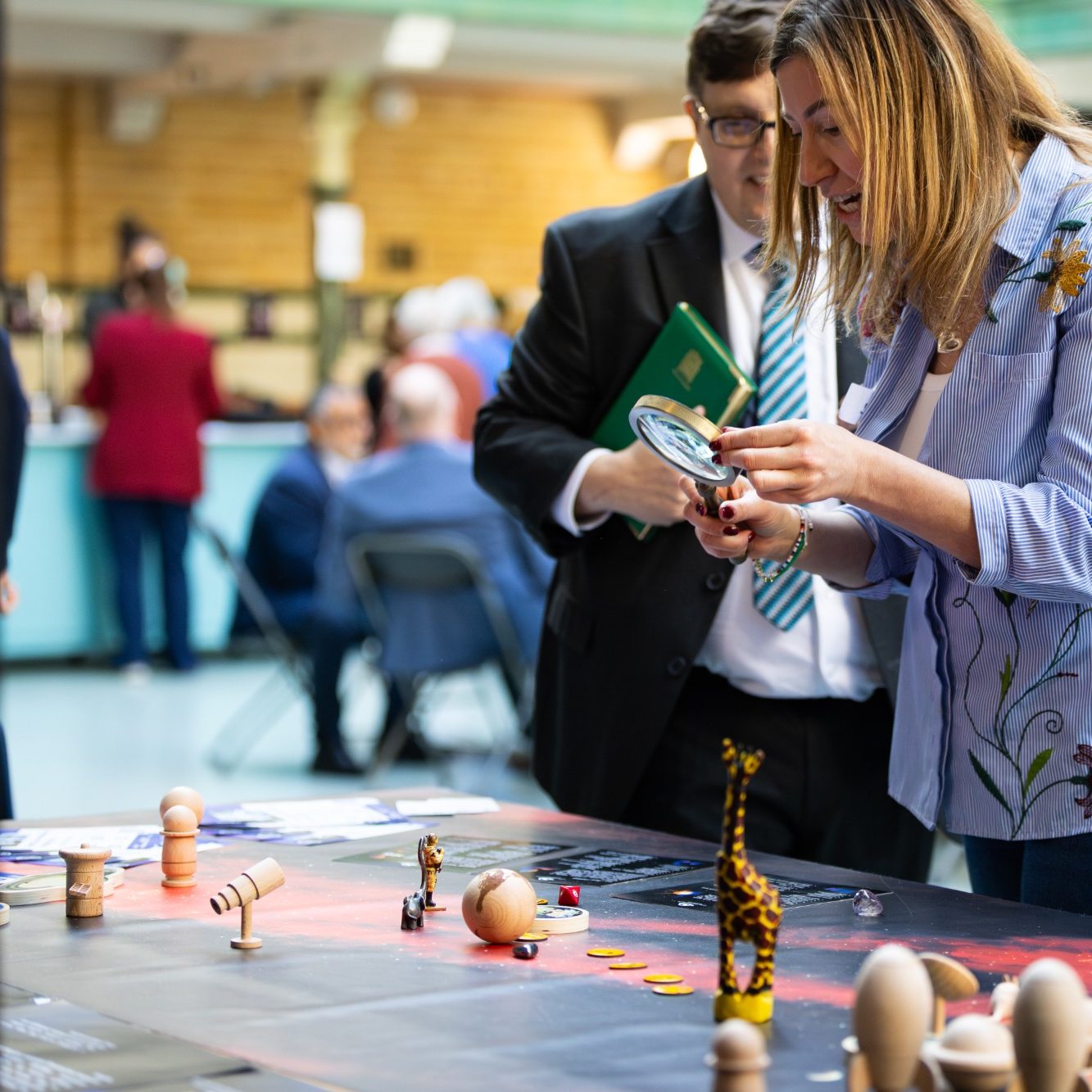
Our action-based programme Strategic Orbits Exercise® allows leaders to rehearse future scenarios in a safe-to-fail enviroment.
From predicting the future to testing decisions
Good foresight does not ask:
“What will happen?”
It asks:
“What could happen, and how would our decisions perform if it did?”
That is a profound shift.
Instead of trying to produce one supposedly accurate view of the future, leaders can explore
multiple plausible futures and stress-test the choices they are considering. This is where I believe serious gaming has a particularly powerful role to play. A well-designed simulation creates a safe environment in which leaders can make decisions, experience consequences and adapt — without having to wait for the real world to provide
the feedback. In effect, you can run the strategy before you run the business.
The value of modelling reality
The most useful models are not necessarily the most complicated. A model becomes powerful when it captures enough of reality to expose the interactions that matter.
Consider a leadership team preparing for a major market disruption.
You could give them a report describing the disruption, or you could put them inside it. They have limited information, a competitor makes an unexpected move, customer behaviour changes, a key assumption turns out to be wrong, they have a constrained budget and three strategic options. They must decide. Then the model responds, and suddenly the conversation changes.
Instead of discussing whether a strategy sounds robust, the team starts asking:
- What assumptions are we relying on?
- Where are we most vulnerable?
- Which decisions are reversible?
- What signals would tell us that our strategy is failing?
- What should we do first?
- What would make us change course?
- How quickly can we respond when our assumptions break?
Those are much more valuable questions.
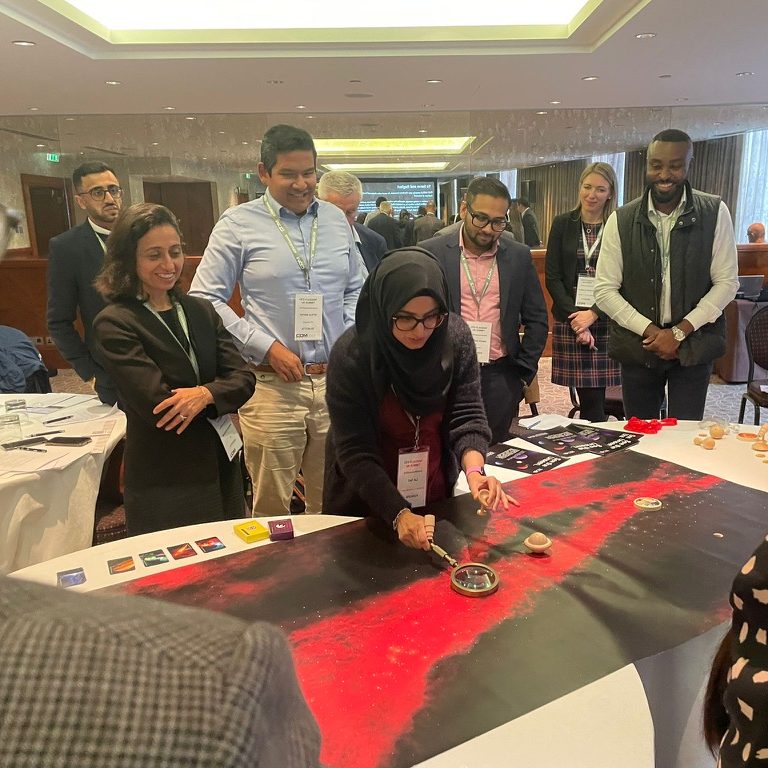
Business leaders using our Strategic Orbits Exercise® to model reality and test business decisions.
Gamification makes the invisible visible
There is sometimes a misconception that gamification means making serious business challenges into games. The opposite is often true.
Serious gaming makes serious consequences visible in a way that conventional analysis often cannot. A simulation creates a compressed experience of uncertainty, participants can see the consequences of their choices, they can experiment, they can make mistakes, they can discover unintended consequences. Most importantly, they can challenge their own assumptions.
Because the experience is interactive, different perspectives emerge. The finance director sees the problem differently from the operations director. The strategist sees a different opportunity from the sales leader. The CEO may discover that the organisation's biggest strategic risk is not the external disruption at all - but its own inability to make decisions quickly enough.
That is the real power of modelling reality.
Foresight needs friction
There is another reason I use serious gaming in foresight work: It introduces productive friction.
In a conventional strategy session, people can unconsciously optimise for consensus.
In a simulation, the consequences of disagreement become tangible:
- Someone has to make the call.
- Someone has to allocate the resources.
- Someone has to decide what information matters.
- Someone has to act before they have all the answers.
That is much closer to leadership in the real world.
The objective isn't to create a perfect prediction, it is to create a better-prepared organisation.
The Leadership Alchemist's question
For me, this sits at the heart of leadership alchemy:
How do we transform uncertainty into something leaders can work with?
We cannot eliminate uncertainty, we cannot know exactly what the future will bring. But we can create environments where leaders rehearse uncertainty, test assumptions and learn how their decisions behave under pressure.
That means moving from: Forecast → Decide → Hope
To: Explore → Simulate → Learn → Adapt
The distinction is important because by the time reality tells you that your strategy doesn't work, the cost of learning
can be enormous. A simulation gives you the opportunity to learn while the stakes are still low.
With the Strategic Orbits Exercise® we use deep scenario design to model reality, empowering decision makers to test their decisions and improve their plans in a safe environment.
Don't wait for the future to test your strategy
The best strategic question may therefore not be: “Do we have confidence in this decision?”
It might be: “What would we learn if we tested this decision against a world that doesn't behave as we expect?”
That is the opportunity offered by serious gaming.
I work with organisations to turn strategic uncertainty into immersive, decision-based experiences - using serious games and simulations to explore possible futures, challenge assumptions and test strategic choices.
Don't just discuss the future. Step into it. Explore my Serious Gaming as a Service → Strategic Orbits Exercise®. Because the future will eventually test your decisions. The question is whether you test them first.
Stay safe, and add value. \
The Leadership Alchemist