Friday 10 April 26
From Modest Beginnings to Trusted Advisor: Leadership, Decision-Making, and Resilience in Uncertainty
By The Leadership Alchemist, a performance optimisation expert who believes in ethical intelligence, practical productivity, and the responsible acceleration of human potential.

A business owner experiencing the Strategic Orbits Exercise® at Manchester Tech Festival.
A Different Starting Point for Leadership
There’s a tendency in leadership to assume that credibility is built in boardrooms, institutions, or established pathways. My experience suggests something different.
I was the first in my family to access higher education. There was no inherited roadmap, no network waiting on the other side; only a belief that education might create a different kind of future. At the time, it wasn’t framed as leadership or strategy. It was simply navigation: Learning how to move through systems where you are not always expected to belong, and where capability does not automatically translate into recognition.
Looking back, that starting point shaped everything that followed. It built gratitude for opportunity, a sensitivity to systems and patterns, a discipline in observation, and a tolerance for uncertainty that remains central to how I operate today.
Operating in Environments Defined by Uncertainty
Over the course of my career, I have worked in environments where uncertainty is not occasional, it is constant. From warzones and crisis management settings to contested environments, and later into advisory roles with governments and senior leadership teams across multiple regions; the common denominator has always been the same: Decisions must be made without perfect information, and often under significant pressure.
In these environments, leadership stops being conceptual. It becomes operational.
You are not working with abstract models of decision-making, you are working with consequences; Human, organisational, and systemic. The ability to remain clear-headed when conditions are unstable is not an additional skill, it is the foundation of effective leadership in today’s context.
Decision-Making Under Pressure
Over time, my focus has increasingly been on how decisions are actually made under pressure, rather than how they are described in theory. What matters most is not complexity for its own sake, but clarity within complexity. The ability to quickly frame a situation, separate patterns from noise, and identify what genuinely drives risk and opportunity. Strong decision-making is rarely about certainty. It is about coherence and pattern recognition. It is about being able to articulate your thinking in a way that allows others to act with confidence even when the environment is shifting in real time. This becomes especially important at board and executive levels, where distance from operational reality can unintentionally soften the perception of risk. A consistent part of my work has been bridging that gap, ensuring that strategic decisions remain grounded in lived operational reality.
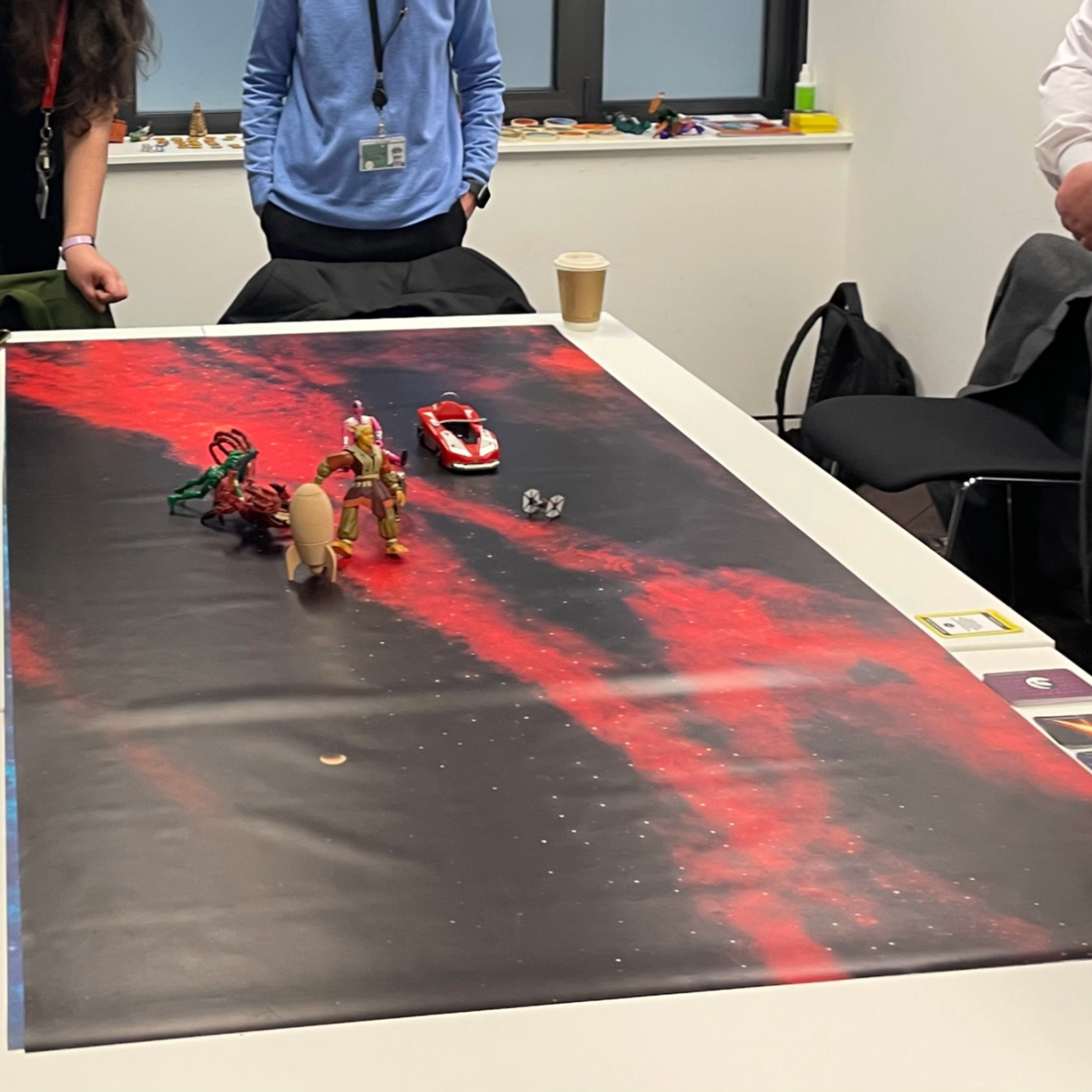
Guiding a Whitehall parliamentary team through the Strategic Orbits Exercise® in a complex and high scrutiny landscape.
Bridging Boardroom and Frontline Reality
One of the most consistent patterns across my advisory work has been the alignment, and sometimes misalignment, between boardroom decision-making and frontline reality.
Boards operate in a space defined by strategic pressure, stakeholder expectations, and incomplete information. Frontline environments operate in immediacy, consequence, and constant change. The challenge is not that these worlds are disconnected, but that they often interpret risk, urgency, and impact differently.
My role has often been to translate between them; to bring operational clarity into strategic environments, and to ensure that decisions remain connected to what is actually happening on the ground.
Resilience as a Function of Exposure
Resilience is often misunderstood as endurance. In practice, it is far more dynamic than that. True resilience is the ability to maintain clarity under sustained pressure, adapt thinking as conditions evolve, and recover quickly from decisions that do not go as expected. Most importantly, it is the ability to continue leading effectively without relying on stability as a reference point.
This kind of resilience is not developed in isolation. It is built through exposure; through environments where stakes are real, timelines are compressed, and outcomes cannot be delayed.
Serious Gaming and Accelerated Learning
One of the most effective ways I have seen leaders develop these capabilities is through serious gaming. By replicating pressure, ambiguity, and consequence in controlled environments, serious gaming creates the opportunity to experience uncertainty without real-world cost. It allows decisions to be tested, outcomes to be observed, and thinking patterns to be refined in real time. It is not about simulation in theory, it is simulation as experience. However, even this is only part of the picture. Because the real challenge in leadership is not only making decisions under pressure, but understanding how those decisions interact across multiple systems at once.
Strategic Orbits Exercise®: Making Complexity Visible
This is where the Strategic Orbits Exercise® comes in.
The Strategic Orbits Exercise® was developed from the intersection of operational experience, crisis environments, board advisory work, and immersive decision-making design. At its core, it is a way of making complexity visible. It helps leaders understand that they are never operating in a single dimension. Instead, they are moving between overlapping “orbits” - operational, strategic, political, and human - each with its own logic, pressures, and consequences.
Decisions made in one orbit inevitably influence the others, often in ways that are not immediately obvious. The exercise is designed to surface those interactions. It enables leaders to see where influence is real, where assumptions are being made, and how decisions propagate through interconnected systems.
In doing so, it changes the way complexity is understood - not as something to be simplified away, but as something to be navigated with greater awareness.
Connecting the Journey
When I reflect on the journey from a modest beginning to working alongside leaders in complex and high-stakes environments, the thread that connects everything is not a single role or experience, but a continuous engagement with uncertainty. My early life built adaptability. Operational environments built my decision-making under pressure. Crisis work refined my judgement. Board advisory work expanded my perspective. Serious gaming created a structured acceleration of my learning. And the Strategic Orbits Exercise® brought it all into a coherent framework.
Final Thought
Leadership today is not defined by stability. It is defined by the ability to operate effectively without it. The leaders who make the most impact are not those who avoid complexity, but those who can move through it with clarity, discipline, and awareness of the systems they are influencing. Because leadership is never truly tested in moments of certainty. It is revealed in moments of uncertainty; and in how well you can still see the system when everything else is moving.
Stay safe, and add value. \
The Leadership Alchemist