Friday 13 March 26
Leadership in a World That Won’t Sit Still
By The Leadership Alchemist, a performance optimisation expert who believes in ethical intelligence, practical productivity, and the responsible acceleration of human potential.
Real leadership development doesn’t happen in a classroom detached from reality. It happens in the middle of events that are messy, political, emotional, and often unfolding faster than leaders can fully understand them. As someone who has spent time working in crisis environments and now coaching leaders across organisations, I’ve learned that the best leadership learning material is often the world itself. Global events are not just headlines. They are live case studies in leadership.
When we pay attention, they reveal patterns about decision-making, adaptability, and collective thinking that are directly relevant to how we lead teams, organisations, and systems. Below are four leadership insights drawn from the current global environment that frequently surface in my action learning conversations with leaders.
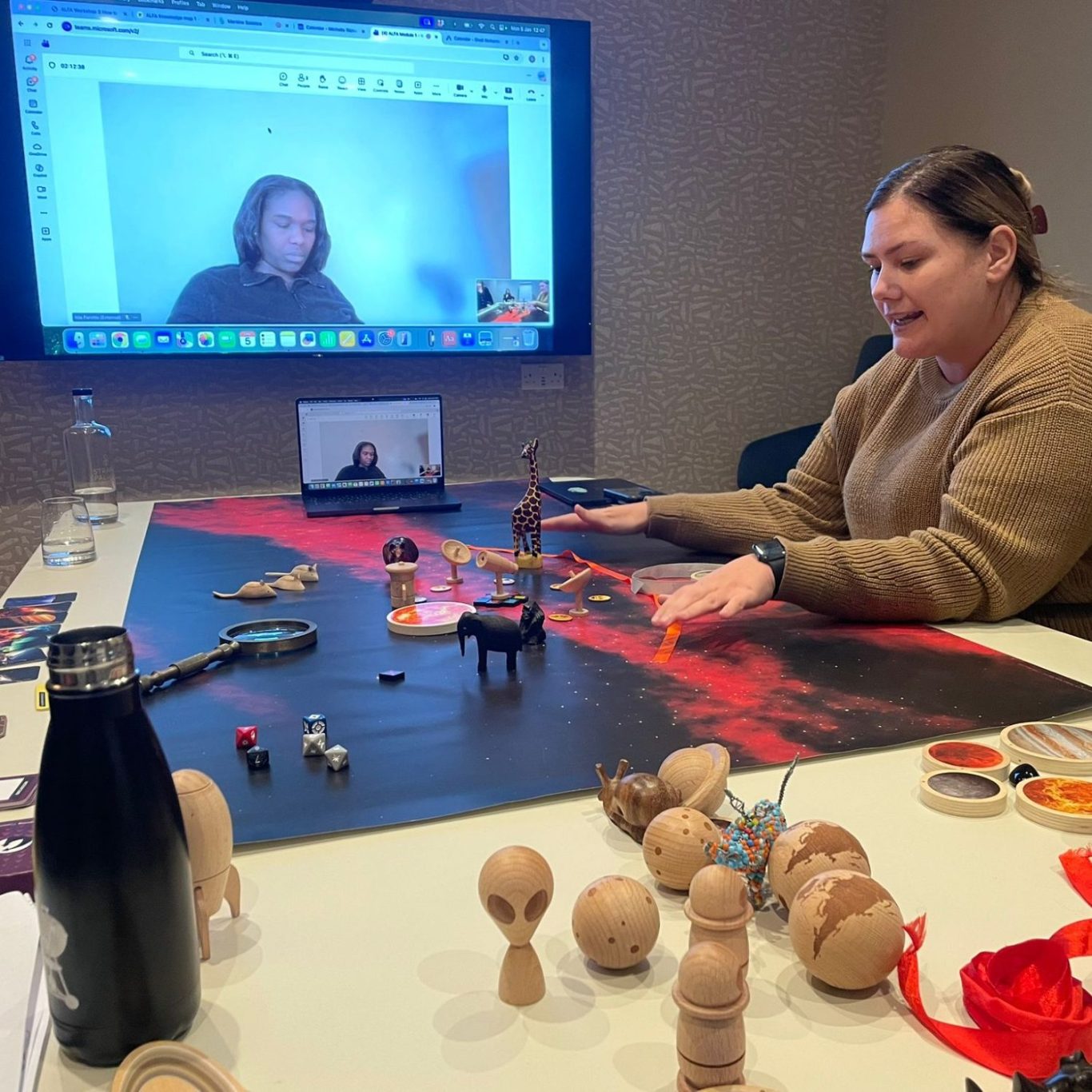
Participants on our Action Learning Facilitator Accreditation programme learning to facilitate systems thinking through the Strategic Orbits Exercise®.
1. Leadership Under Pressure: Acting Without Complete Information
Major crises, such as the Russian invasion of Ukraine or the current war between Iran and Israel and the United States demonstrate a fundamental leadership truth:
Leaders rarely get the luxury of perfect information.
In crisis environments, leaders must:
- Make decisions before all the facts are available
- Adjust rapidly as new information emerges
- Learn whilst acting rather than waiting to learn first
This is uncomfortable for many organisations that are conditioned to seek certainty before moving. But effective leadership in volatile environments requires simultaneous action, learning, and adaptation.
Reflection question:
When was the last time you had to lead decisively without having all the answers?
2. AI and the Future of Leadership: The Power of Better Questions
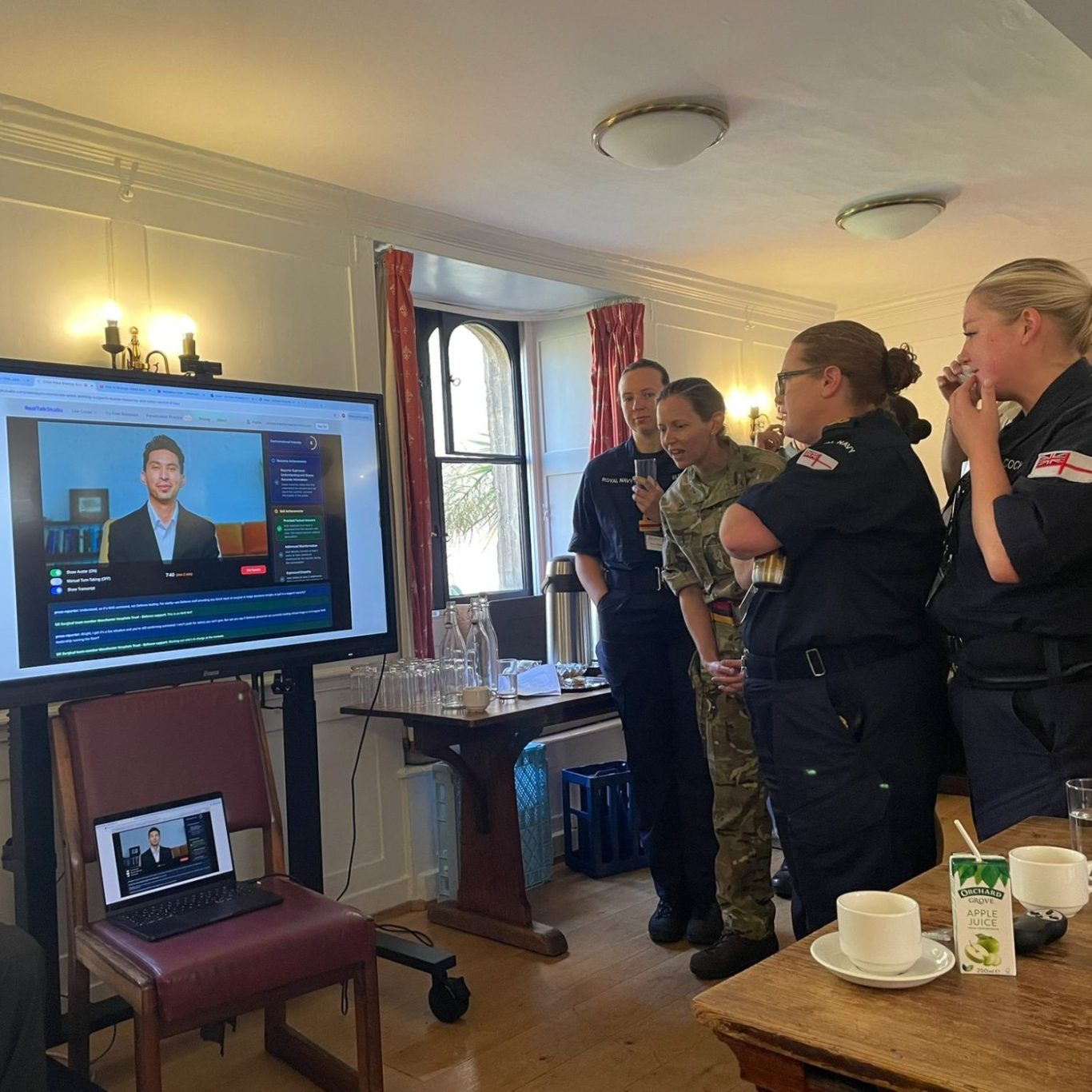
Demonstrating our AI-enablers to British Military personnel. There is still much to do to prepare public sector leaders to lead AI transformation.
The rapid rise of AI tools is reshaping how knowledge work happens. For leaders, the key shift is this: Answers are becoming abundant. Questions are becoming strategic.
AI can provide analysis, ideas, and content at extraordinary speed. What it cannot replace is the human judgement that determines which questions are worth asking in the first place.
This places a new responsibility on leaders to:
- Frame better problems
- Ask deeper questions
- Create environments where curiosity and exploration are valued
In many ways, leadership is becoming less about having the answers and more about designing the thinking process.
Reflection question:
What question should your organisation be asking right now that no one is asking yet?
3. Leadership in Polarised Environments: Holding the Space
Political division across the United States and Europe highlights another leadership challenge: How to lead when perspectives are deeply divided. Polarisation is not confined to politics. It shows up inside organisations as well; in debates about strategy, culture, technology and change.
In these environments, leaders play a critical role. Not by forcing agreement. But by creating spaces where people can think together despite disagreement.
This requires leaders to:
- Encourage dialogue rather than shutting it down
- Hold multiple perspectives without rushing to simplify them
- Facilitate collective thinking in complex situations
The skill here is less about persuasion and more about stewardship of the conversation.
Reflection question:
How do you create space for difficult conversations in your team?
4. Leading Through Economic Uncertainty
Across the United Kingdom and much of the global economy, organisations are navigating inflationary pressures, shifting markets, and evolving workforce expectations. Periods like this test leadership in a different way. When resources tighten and uncertainty grows, many organisations instinctively become cautious and inward-looking.
Yet history shows that the organisations that emerge strongest from uncertain periods are those that learn faster than the environment changes.
In practise this means leaders must:
- Encourage experimentation rather than paralysis
- Support rapid learning cycles
- Build organisational adaptability
Uncertainty doesn’t just test leadership capability. It reveals it.
Reflection question:
What capability does your organisation need to learn fastest over the next 12 months?
A Leadership Habit: Turning World Events into Learning
One of the simplest and most powerful leadership development practices is this:
Use world events as prompts for reflection and learning.
The formula is simple:
World Event + Reflection Question = Leadership Insight
It works particularly well in action learning environments, leadership teams, and coaching conversations.
For example:
A geopolitical crisis becomes a conversation about decision-making under pressure.
A technological breakthrough becomes a discussion about the future of leadership capability.
Economic shifts become prompts for thinking about resilience and adaptability.
Leadership development becomes more powerful when it is grounded in the real world rather than abstract theory.
Lessons from the Pandemic
If the COVID-19 pandemic taught leaders anything, it was this: Leadership learning must be public, fast, and continuous. The most effective leaders during that period were not those who claimed certainty. They were the ones who:
Shared what they knew and what they didn’t know
Adjusted their approach as conditions changed
Learned alongside their teams rather than pretending to be ahead of them
In other words, they practiced leadership as an ongoing learning process.
Final Reflection
The world will not slow down for leaders. Crises will emerge. Technologies will evolve. Political and economic conditions will shift. But within that turbulence lies a powerful opportunity. If we treat global events not just as news but as leadership laboratories, we can develop sharper judgement, deeper insight, and stronger collective thinking.
Because leadership today is not about waiting for certainty. It is about learning fast enough to lead through uncertainty.
Stay safe, and add value. \
The Leadership Alchemist