Friday 23 October 2026
Rehearsing the Plan Is Not Wargaming: Why the Distinction Matters for Serious Leaders
By The Leadership Alchemist, a performance optimisation expert who believes in ethical intelligence, practical productivity, and the responsible acceleration of human potential.

Extending Reality for military medical leaders through controlled avatar-based real plays in our strategic tabletop game Strategic Orbits Exercise®.
Strategy | Leadership | Decision Intelligence | Professional Wargaming
There is a growing tendency to describe almost any facilitated scenario, tabletop discussion, strategic workshop or leadership exercise as wargaming. Put a map on a table, assign participants different roles, introduce a hypothetical crisis, and invite people to discuss what they would do. Add a few decision points and a dramatic scenario, and the activity may suddenly acquire the language of professional wargaming.
But changing the label does not change the underlying method.
For leaders responsible for complex decisions, the distinction is more than semantic. It determines whether an organisation is practising a known plan, developing collective understanding, exploring competing strategies, or genuinely examining how decisions interact with the actions of other actors in an uncertain environment.
These activities can all be valuable. They are not interchangeable.
At The Leadership Alchemist, we believe that serious leadership demands intellectual honesty about the tools used to support it. Professional wargaming is one such tool. It deserves to be understood on its own terms, rather than diluted into a fashionable label for activities that may have little to do with the discipline itself.
The central argument is straightforward:
A rehearsal practises a plan. A professional wargame explores what happens when decisions collide. A serious game is a broader category of designed activity in which play serves a consequential purpose.
Understanding the differences is essential to choosing the right method, asking the right questions and obtaining insights that can withstand scrutiny.
1. Start with the purpose, not the props
One of the most persistent misconceptions about wargaming is that it can be identified by its physical appearance.
Maps, counters, scenario cards, role assignments, injects, digital interfaces and facilitated discussions may all feature in a wargame. None of them, individually or collectively, guarantees that wargaming is taking place.
The defining issue is not whether an activity looks like a game. It is how the activity is designed to generate insight.
The UK Ministry of Defence's Wargaming Handbook provides a particularly useful starting point. It describes wargaming as a decision-making technique that creates structured, safe-to-fail environments for exploring what works and what does not. It emphasises adversarial challenge, player decisions, the evolving narrative and the lessons participants take away.
The US Naval War College similarly places human decisions, conflict or competition, and the consequences of those decisions at the centre of its understanding of wargaming.
These are not incidental characteristics. They explain why wargaming can reveal vulnerabilities that conventional planning discussions may leave undiscovered.
Sources: UK Ministry of Defence, Wargaming Handbook; US Naval War College, About Wargaming.
A useful first test is therefore to ask:
What question is this activity intended to answer?
What decisions will participants actually have to make?
Who or what will oppose their intentions?
How will the consequences of those decisions be determined?
What can happen that the participants did not anticipate?
What evidence or reasoning will support the conclusions?
If the answers are unclear, the activity may still be a useful workshop, discussion or rehearsal. But its claim to be a professional wargame has not yet been established.
2. Rehearsing a plan: preparing people to execute
A rehearsal has an important and legitimate purpose: to improve the execution of an established plan, procedure or intended course of action.
Participants need to understand their responsibilities, the sequence of events, the timing of actions, the interfaces between teams and the conditions under which they must act. They may practise communications, confirm handovers, identify coordination problems and ensure that everyone understands the intended outcome.
Consider an organisation preparing to respond to a major cyber incident.
The leadership team has approved an incident-response plan. A rehearsal might walk participants through the initial alert, escalation to the executive team, activation of technical specialists, communications approval and notification of relevant stakeholders.
The purpose is to establish whether the participants understand the procedure and can execute it coherently.
That is worthwhile work. A beautifully designed strategy is of little value if the people responsible for implementation cannot carry it out.
However, a rehearsal generally begins with an intended sequence of actions that participants are expected to practise or coordinate. Deviations may be introduced to test execution, but the principal objective remains the effective performance of the prescribed plan or procedure.
The key question is:
Can we execute what we have decided to do?
A rehearsal is particularly appropriate when the organisation needs to:
Confirm individual and collective responsibilities.
Practise a defined procedure or sequence of actions.
Synchronise activities across teams.
Validate communications and escalation arrangements.
Improve speed, coordination and execution.
Identify practical obstacles to implementing an agreed plan.
Rehearsals can incorporate unexpected events, challenging injects and simulated opposition. They do not automatically become wargames as a result. Their classification depends on the purpose and the way decisions, opposition and consequences are handled.
The important distinction is between practising a response and investigating how competing decisions might change the situation itself.
A rehearsal can tell us whether people know what to do. It does not, by itself, establish whether the underlying plan is strategically sound.
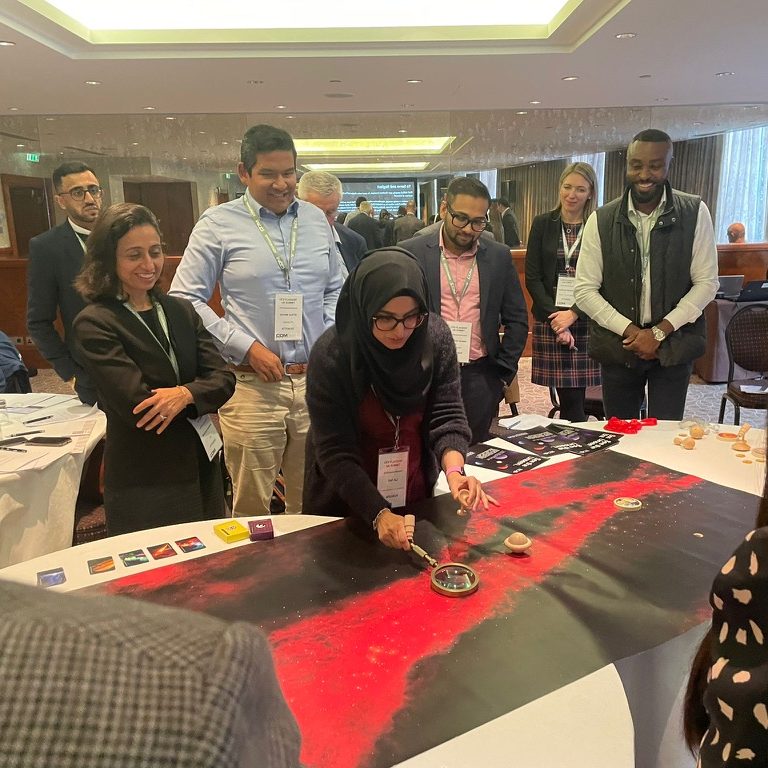
Bringing the physical and digital together with C-Suite leaders during a live decision-making exercise: Strategic Orbits Exercise®.
3. Professional wargaming: putting decisions under pressure
Professional wargaming addresses a different problem.
Rather than concentrating principally on the execution of an agreed plan, it creates a structured environment in which participants make decisions, encounter opposition and experience the consequences of choices as the situation develops.
The outcome is not simply a predetermined sequence to be followed. It emerges through the interaction of player decisions, the scenario, the rules or adjudication method, and the actions of other actors.
This is the essential distinction.
A plan may appear coherent when its authors control the assumptions, imagine how other actors will respond and mentally move from one intended action to the next. The same plan may look very different when another intelligent, motivated actor is free to pursue competing objectives.
A professional wargame makes that interaction the object of investigation.
Return to the cyber incident example.
Instead of rehearsing the incident-response procedure, a wargame might explore a coordinated cyberattack in which the organisation's technical response, executive decisions, regulatory obligations, commercial pressures, media exposure and an intelligent adversary interact.
Participants must decide whether to isolate systems, preserve evidence, disclose the incident, engage external specialists or continue operating with degraded services.
The opposing side may adapt to the organisation's choices. New information may emerge. Actions that initially appear prudent may create vulnerabilities elsewhere. A decision to preserve operational continuity may increase exposure; an attempt to contain the incident may disrupt critical services.
The value lies in the decisions and their consequences, not in whether participants successfully recite the response plan.
The question becomes:
What happens when our decisions meet the decisions of others, particularly when those others do not behave as we expect?
This is why the UK Ministry of Defence handbook emphasises that wargames are dynamic, decision-driven activities. It also distinguishes wargame execution from a planning exercise: execution is where players enact decisions and confront their consequences.
Source: UK Ministry of Defence, Wargaming Handbook.
What makes the wargame professional?
Professional wargaming is not defined by expense, technological sophistication or military aesthetics. Nor does it require an elaborate computer model.
A simple manual game can be rigorous. A sophisticated digital simulation can fail to provide useful wargaming insight.
Professionalism resides in the quality of the design, the suitability of the method, the integrity of adjudication and the discipline with which findings are interpreted.
A credible professional wargame normally has the following characteristics.
1. A clearly articulated purpose
The design begins with a decision problem, research question, learning objective or strategic uncertainty. The game is constructed to serve that purpose rather than simply to entertain participants or create an engaging event.
2. Meaningful player decisions
Participants must make choices that affect what happens next. If the scenario progresses independently of their decisions, or if choices have no meaningful consequences, the central mechanism of wargaming is missing.
3. Opposition or consequential friction
Other players, represented actors or the environment must be able to frustrate, challenge or complicate the participants' intentions. Opposition should reflect the problem being investigated, rather than merely provide theatrical drama.
4. A defensible method of adjudication
The design needs a credible way of determining what follows from player decisions. This may involve rules, structured expert judgement, quantitative models, qualitative adjudication or a combination of methods. The approach must be appropriate to the question and applied consistently enough to support meaningful interpretation.
5. An appropriate relationship with evidence
Assumptions, constraints and relevant evidence must be made explicit. The game should reflect the important features of the problem without pretending to reproduce every detail of reality.
6. Structured analysis and learning
The activity must generate more than anecdotes. Observations, decisions, consequences, disagreements and emerging insights need to be captured and examined against the original purpose.
7. Intellectual honesty about limitations
A wargame can expose vulnerabilities, challenge assumptions, generate hypotheses and illuminate plausible courses of action. It cannot, merely by being played, prove that a strategy will succeed or predict the future with certainty.
The US Government Accountability Office's review of Department of Defense wargaming reinforces the importance of quality principles, analytical practice and appropriate professional capability. It also highlights continuing challenges around the education and qualifications of wargamers.
Professional wargaming is therefore a discipline of structured inquiry. The game is the method; better-informed decisions are the intended benefit.
4. Serious gaming: the wider category
The third concept, serious gaming, is frequently confused with professional wargaming.
The confusion is understandable because the two can overlap substantially.
A serious game is generally understood as a game designed primarily or partly to achieve a purpose beyond entertainment. That purpose might be education, leadership development, policy exploration, organisational learning, behavioural change or decision support.
A serious game may be competitive or cooperative, digital or physical, individual or collective. It may model a complex system, explore ethical dilemmas, teach a process or help participants understand the consequences of their choices.
For example, a leadership development programme might use a serious game in which executives allocate scarce resources, negotiate with stakeholders and manage competing organisational priorities.
The exercise could be highly valuable. It might reveal how participants handle uncertainty, collaborate under pressure or respond to conflicting incentives.
But it is not necessarily a wargame.
If the activity is principally designed to teach negotiation, develop teamwork or reinforce a leadership competency, its primary classification may be serious gaming or experiential learning. It becomes a wargame when the design and conduct meet the relevant requirements for exploring consequential decisions within a model of conflict or competition.
There is no need to treat these categories as mutually exclusive. Wargaming can be understood as a specialised form of serious gaming, while serious gaming encompasses many activities that are not wargames.
The important point is that a serious purpose does not automatically make an activity a wargame, just as an engaging game does not automatically make it analytically rigorous.
The distinction is supported by the broader literature. In his 2022 article The Use and Misuse of Wargames, Tom Mouat examines the diversity of wargaming practice and the confusion surrounding its definition, arguing for attention to the task and purpose being served.
Source: Tom Mouat, The Use and Misuse of Wargames, Scandinavian Journal of Military Studies (2022).
5. The most dangerous mistake: confusing confidence with evidence
Why does this distinction matter so much to senior leaders?
Because an activity can create confidence without generating the evidence needed to justify that confidence.
Imagine that an executive team gathers to examine its response to a major supply-chain disruption. The facilitator presents a plausible scenario. Participants discuss the problem, explain their preferred responses and agree that the organisation would manage the situation effectively.
The session is engaging. Everyone contributes. The leadership team leaves reassured.
But what has actually been established?
Perhaps the team has demonstrated that it understands the existing plan. Perhaps it has identified a few procedural gaps. Perhaps the discussion has surfaced useful questions.
Those are legitimate outcomes.
However, unless the design allows meaningful alternative decisions, credible opposition, consequential uncertainty and disciplined analysis, it may not have tested the strategic assumptions underpinning the organisation's confidence.
Did the team examine what would happen if a critical supplier acted in its own interests? Did it consider how a competitor might exploit the disruption? Did it explore the consequences of competing executive priorities? Were participants forced to make difficult choices under constraints, or were they simply invited to discuss hypothetical responses?
Most importantly, could the activity have produced a materially different conclusion from the one participants expected at the outset?
A well-designed wargame should create the possibility of surprise. It should allow the organisation's preferred assumptions to be challenged by the interaction of decisions and consequences.
That does not mean every game must produce a dramatic reversal or an unexpected result. Sometimes the most useful finding is that a strategy remains robust across several plausible challenges.
But that conclusion is more credible when the method has genuinely exposed the strategy to those challenges.
The danger is not that rehearsals or workshops are ineffective. It is that leaders may mistake the benefits of one method for evidence that only another method can provide.
Reassurance is not validation. Discussion is not experimentation. And a confident conclusion is not necessarily a well-founded one.
6. Professional wargaming is not fortune-telling
There is another misconception worth addressing: that a wargame can identify the future winner, predict the precise sequence of events or prove that a particular strategy will succeed.
It cannot do so simply by virtue of being a wargame.
A game is a designed representation of selected aspects of a real or hypothetical problem. It necessarily simplifies reality. Its findings are shaped by the scenario, the participants, the information available, the rules, the adjudication method and the assumptions built into the design.
The consequences observed during play are therefore not automatically predictions of real-world outcomes.
The US Naval War College explicitly cautions that wargames are useful for investigating processes, exploring issues and generating insights, but do not, by themselves, calculate real-world outcomes, prove theories or predict winners.
Source: US Naval War College, About Wargaming.
A professional wargame should instead help decision-makers understand the mechanisms through which outcomes might emerge.
It may reveal that a strategy depends on an optimistic assumption about an opponent's behaviour. It may expose an overlooked dependency. It may demonstrate how one actor's apparently rational choice creates an unexpected problem for another. It may identify a question that requires further research, modelling or empirical testing.
Those are meaningful contributions.
The value of wargaming is not that it provides certainty about an uncertain future. It is that it helps people reason more rigorously about uncertainty, competition and the consequences of their own decisions.
7. A practical test for separating substance from imitation
As wargaming becomes more widely discussed in leadership, strategy, consulting and organisational development, the vocabulary of the discipline will inevitably spread.
That is not inherently a problem. Wider adoption can be beneficial. Many organisations would make better decisions if they examined their assumptions through structured, adversarial play.
The problem arises when the terminology travels further than the underlying competence.
A useful way to distinguish substantive practice from superficial imitation is to examine the design before the event and the analysis after it.
Ask a provider the following questions.
Before the game
What is the precise decision problem or research question?
Why is wargaming the appropriate method rather than a rehearsal, workshop, exercise or other form of analysis?
How will the scenario represent the factors that matter to the question?
How will the interests and freedom of action of opposing actors be represented?
How will player decisions change the developing situation?
How will consequences be adjudicated, and what assumptions underpin that process?
What outputs will the sponsor receive, and how will they inform an actual decision?
After the game
Which assumptions were challenged?
Which decisions created unexpected consequences, and why?
What did the opposing players reveal about the vulnerabilities of the preferred strategy?
Which findings were robust, and which depended on uncertain assumptions or particular player choices?
What new questions emerged?
What further evidence, analysis or experimentation is required?
How will the findings be translated into changes to plans, policies, capabilities or leadership practice?
These questions do not impose a single methodology on every game. Professional wargaming is diverse, and a strategic policy game should not necessarily resemble a tactical military game.
They do, however, require the provider to explain the relationship between the method, the problem and the claimed value.
A provider who can articulate that relationship demonstrates something more important than familiarity with gaming terminology: an understanding of why the method works, where it is useful and where its limitations lie.
8. What this means for leadership beyond defence
Although professional wargaming has deep roots in military education, planning and analysis, its relevance is not confined to defence.
Organisations increasingly face decisions in environments characterised by competing interests, adaptive opponents, incomplete information and consequences that cannot be understood by examining one actor in isolation.
Consider a company preparing to enter a contested market.
A rehearsal might prepare its leadership team to execute a launch plan.
A serious game might help executives develop negotiation skills, practise cross-functional collaboration or explore different leadership behaviours.
A professional wargame could examine how competitors, customers, regulators, suppliers and other relevant actors might respond to the company's strategic choices, and how those responses could alter the decision environment.
These approaches may complement one another, but they answer different questions.
The same distinction can be applied to organisational transformation, crisis leadership, geopolitical risk, investment strategy, public policy and major programme decisions.
Whenever outcomes depend on how multiple actors respond to one another, wargaming may offer a valuable means of examining those interactions before committing resources in the real world.
But relevance alone is not sufficient. The method must still be designed to suit the problem, and its findings must be interpreted with appropriate caution.
Not every leadership challenge needs a wargame. Professional judgement includes knowing when a different method is better suited to the task.
That is the mark of methodological competence: selecting the right tool, rather than forcing every problem into the tool one happens to sell.
9. The real test of professionalism
Professional wargaming is not defined by branding, vocabulary, elaborate props or the confidence with which a facilitator describes an event.
It is defined by the disciplined relationship between the problem being investigated, the decisions participants make, the consequences they encounter and the insights that can reasonably be drawn from the experience.
A rehearsal helps people execute.
A serious game uses play to achieve a broader purpose.
A professional wargame creates a structured environment in which consequential decisions interact, assumptions are challenged and alternative possibilities can be explored.
Each has a place. Each can be valuable. Each deserves to be judged by its intended purpose and the quality of its design.
The mistake is to treat them as equivalent simply because they share some techniques or outward characteristics.
For leaders, the consequences of that mistake can be significant. An organisation that needs to test a strategy may receive a rehearsal. A team that needs to examine competitive behaviour may receive a facilitated discussion. A decision-maker who needs robust insight may receive an entertaining experience accompanied by conclusions the method cannot support.
None of those outcomes is inevitable. But avoiding them requires a clear understanding of what professional wargaming actually entails.
At The Leadership Alchemist, we advocate a more demanding standard: begin with the decision that matters, choose the method that fits, challenge assumptions rather than merely repeat them, and distinguish what the activity reveals from what it cannot establish.
Because leadership is not about making a plan look convincing.
It is about understanding what might happen when that plan encounters a world that does not have to cooperate.
And that is precisely where the difference between rehearsing a plan and wargaming becomes consequential.
References and further reading
The following sources provide a foundation for readers who want to explore the concepts, methods and limitations of professional wargaming in greater depth.
UK Ministry of Defence. (2017). Wargaming Handbook. Development, Concepts and Doctrine Centre. A foundational guide to the purposes, design and conduct of wargaming across defence, including planning, education and decision support.
https://www.gov.uk/government/publications/defence-wargaming-handbook
US Naval War College. About Wargaming. An institutional overview of wargaming definitions, analytical and educational purposes, and the distinction between wargames, exercises, seminars and simulations.
https://usnwc.edu/Research-and-Wargaming/Wargaming/About-Wargaming
Mouat, T. (2022). “The Use and Misuse of Wargames.” Scandinavian Journal of Military Studies, 5(1). An examination of the terminology, purposes and practical challenges associated with wargaming.
https://doi.org/10.31374/sjms.121
US Government Accountability Office. (2023). Defense Analysis: Additional Actions Could Enhance DOD's Wargaming Efforts. GAO-23-105351. An assessment of Department of Defense wargaming provision, quality principles, professional capability and institutional challenges.
https://www.gao.gov/products/gao-23-105351
McCarty Little, F. J. (1966). Fundamentals of War Gaming. Third edition. US Naval War College. A historically important work on the purposes and practice of wargaming, particularly the generation of decision-making experience and information.
Appleget, J., Burks, R., & Cameron, F. (2020). The Craft of Wargaming: A Detailed Planning Guide for Defense Planners and Analysts. Naval Institute Press. A practical treatment of wargame design and planning for analytical and defence applications.
Editorial note: Definitions and boundaries vary across professional communities. The distinctions in this article concern the primary purpose and method of each activity, rather than suggesting that every exercise must fit a single rigid category.
Stay safe and add value.
The Leadership Alchemist