Saturday 28 Febuary 26
Resilience by Design – Gaming through Crisis with the Strategic Orbits Exercise®
By The Leadership Alchemist, a performance optimisation expert who believes in ethical intelligence, practical productivity, and the responsible acceleration of human potential.
Early in my career, resilience was not just a strategic priority. It was survival. Operational deployments in Iraq, Afghanistan and Palestine taught me something that has remained constant across every environment since: Organisations rarely fail because they lack intelligence or resources. They fail because they misread compounding risk and early warning signs; because decisions slow down under pressure, and because assumptions remain unchallenged until reality corrects them.
Years later, during the COVID-19 pandemic, working within Whitehall, the context was different, but the pattern was identical. Ambiguity expanded faster than reliable information. Decision cycles compressed whilst scrutiny intensified. Human systems, financial systems and operational systems were all stressed simultaneously. The institutions that endured were not necessarily the most resourced. They were the most adaptive.
That distinction matters profoundly in today’s boardrooms.
Although corporate risk may not carry kinetic consequences, it always carries capital consequences. And in high-stakes environments, fragility behaves in the same manner; whether on a battlefield or on a balance sheet.
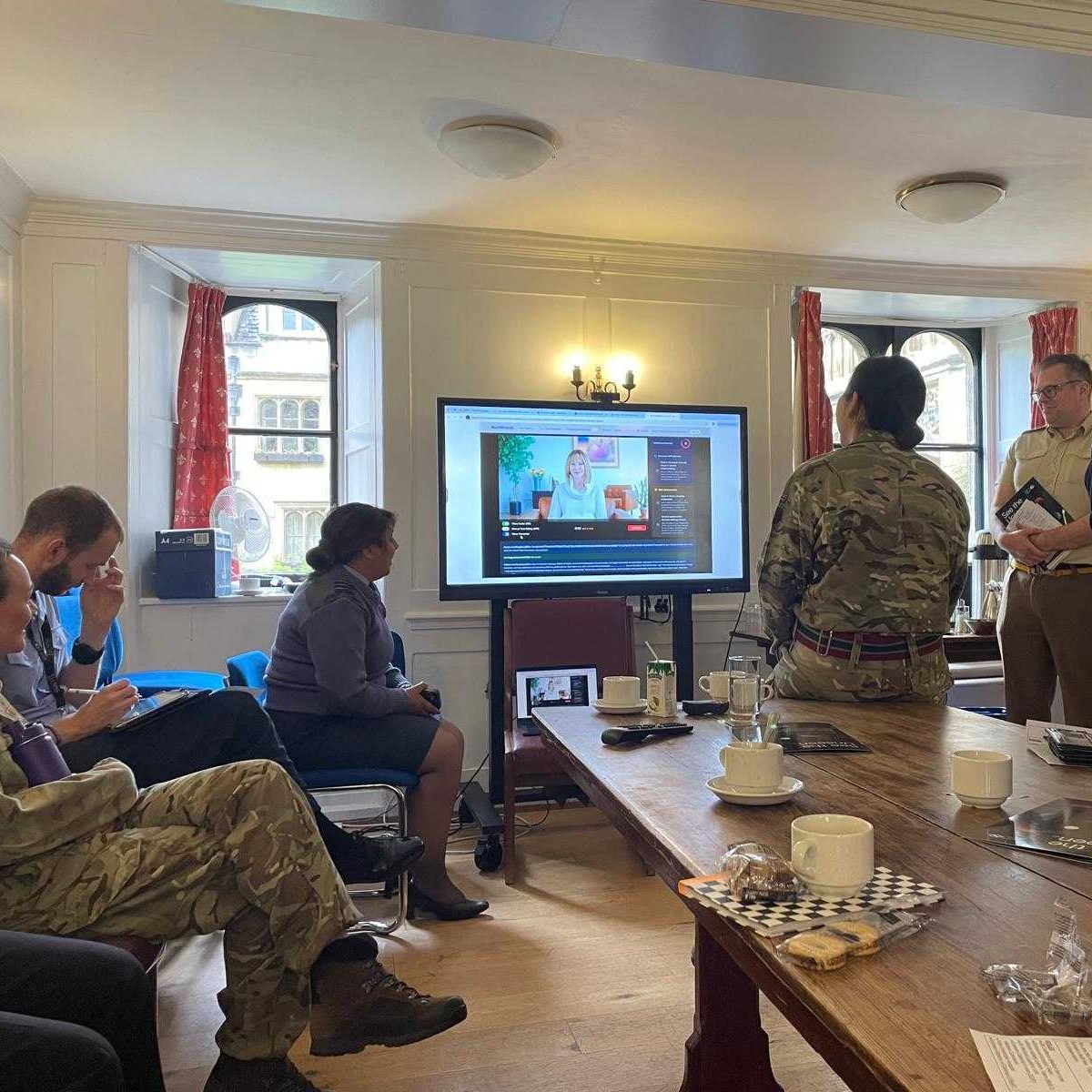
Frontline military and NHS surgeons taking part in AI- enabled simulations as part of the Strategic Orbits Exercise®.
The Quiet Fragility Inside Executive Systems
Most large organisations are built for productivity optimisation, not volatility. They are engineered to deliver efficiency, scale and predictable returns. Governance frameworks are robust, reporting cycles are disciplined and compliance structures are sophisticated.
Yet few executive systems are deliberately conditioned to operate coherently when those structures are destabilised or destroyed.
In volatile environments, failure rarely announces itself dramatically. It accumulates. Leadership alignment erodes subtly under pressure. Escalation pathways clog. Capital remains tied to outdated strategic assumptions. Interdependencies across functions reveal themselves too late. By the time financial exposure becomes visible externally, the internal system has already begun to fracture.
For decision-makers and budget holders, this is not abstract theory. It is enterprise value risk.
The strategic question, therefore, is not whether risk exists. It is whether your organisation has engineered the capacity to adapt when a risk materialises into a live issue.
From Operational Simulation to Board-Level Resilience
In conflict environments, we did not prepare for single scenarios. We prepared for ‘families’ of uncertainty. Serious gaming and simulation were not intellectual exercises; they were real time cognitive conditioning. Leaders were exposed to ambiguity in controlled environments so that when it appeared in real time, their decision quality did not collapse.
That operational philosophy became the foundation for the Strategic Orbits Exercise®.
We designed this unique facilitated experience to translate conflict-proven serious gaming methodologies into a board-level resilience instrument. It is not a workshop. It is not a theoretical risk conversation. It is a structured simulation framework that maps how disruption propagates through an enterprise and conditions leadership teams to respond coherently before real-world consequences crystallise.
The core insight is simple but often overlooked: Risk does not arrive in isolation. It travels in expanding orbits.
A regulatory event does not remain regulatory. It becomes reputational. Reputational pressure affects liquidity and investor confidence. Liquidity stress reshapes operational decisions. Operational strain affects talent retention and culture. What began as a contained issue becomes systemic exposure.
The Strategic Orbits Exercise® empowers executive teams to visualise and stress-test those expanding rings of consequence in advance. By doing so, it surfaces hidden interdependencies, exposes single points of failure and challenges capital allocation decisions before they are locked in.
For boards, this translates directly into reduced systems risk and improved downside protection.
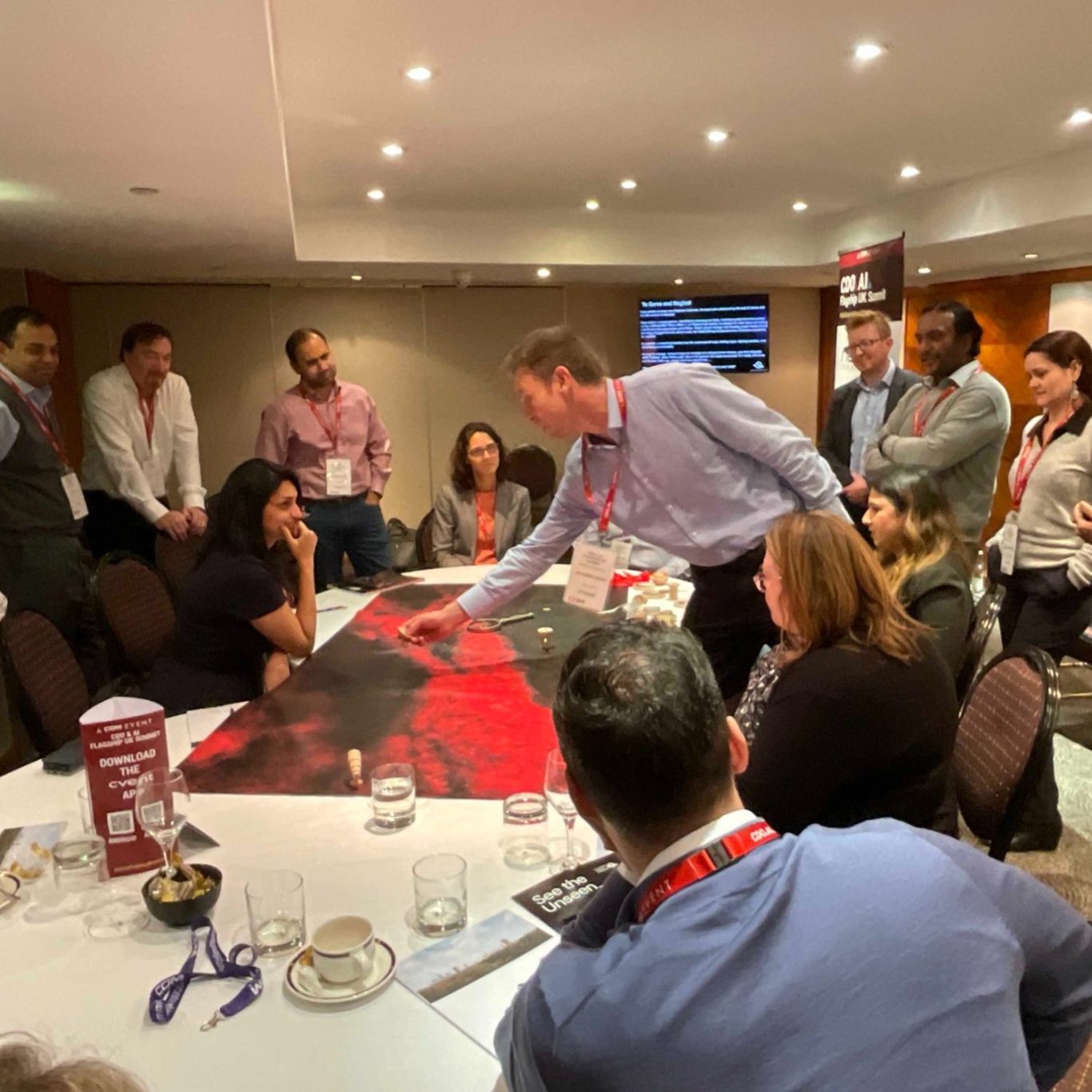
C-Suite Leaders being put through their paces in the Strategic Orbits Exercise®.
Conditioning Leadership Before the Test
One of the most underestimated risks in high-stakes environments is human degradation under pressure. Highly capable leaders can become misaligned, overly centralised or paralysed when ambiguity intensifies.
In military contexts, we never assumed composure would appear spontaneously during crisis. It was trained. Leaders rehearsed operating with incomplete information, compressed timelines and competing priorities. They learned to delegate decisively, to recalibrate when assumptions failed and to coordinate across silos under stress. This is known in military vernacular as the ‘train hard, fight easy’ philosophy.
The Strategic Orbits Exercise® applies that same conditioning discipline to executive teams. Through carefully designed simulations, leadership groups experience synchronised and highly realistic financial, operational and reputational stress within a controlled environment. They see how their own system behaves when strained. They identify friction points in decision rights, governance clarity and information flow.
The result is not theoretical insight. It is improved decision velocity, stronger cross-functional trust and greater cohesion under pressure. In financial terms, that means reduced human risk at precisely the moments when human error is most expensive.
Protecting Capital by Exposing Assumptions
Perhaps the most commercially significant dimension of resilience lies in assumption risk. Capital is deployed on the basis of beliefs about market stability, regulatory continuity, supply chain reliability and transformation pacing. When those assumptions shift abruptly, the cost of miscalculation can be profound.
The Strategic Orbits Exercise® deliberately stress-tests those assumptions before capital becomes irrecoverable. It creates structured environments in which executive teams confront non-linear outcomes, adversarial dynamics and cascading second-order effects. In doing so, it frequently surfaces vulnerabilities that traditional planning processes miss.
Across multiple engagements, this has led to earlier identification of regulatory cascade exposure, recalibration of transformation sequencing, mitigation of digital dependency fragility and preservation of strategic optionality. In each case, the financial impact of early insight materially outweighed the investment in the exercise itself.
For budget holders, this is not discretionary development spend. It is proactive capital protection.
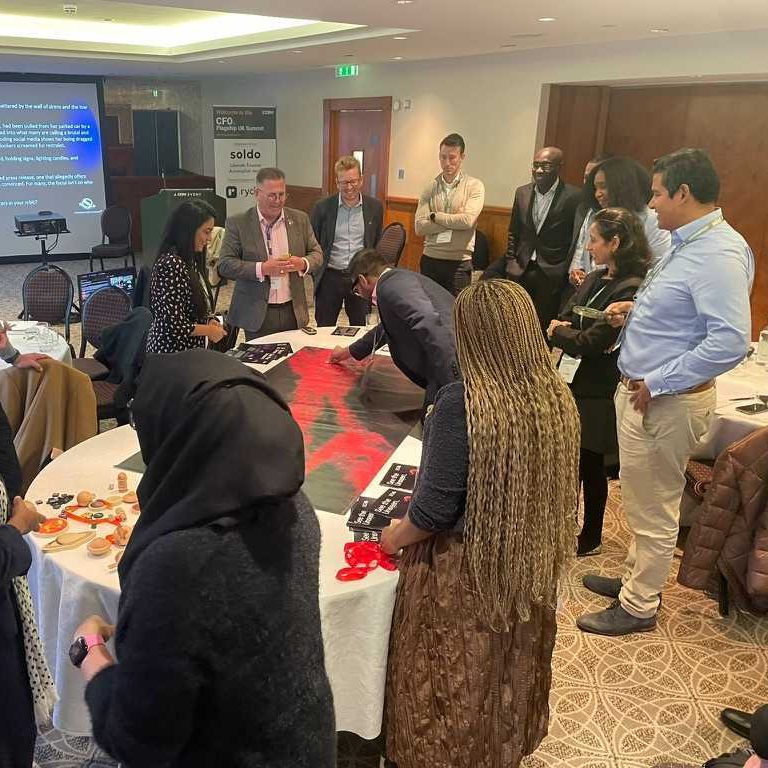
Global CFOs and CISOs addressing the financial, data and information risks of a live Strategic Orbits Exercise® scenario.
The Case for Investment Now
The volatility stack facing boards today is unlike that of any previous decade. Geopolitical fragmentation, accelerated technological disruption, systemic cyber vulnerability, regulatory activism and climate-linked instability are converging simultaneously. The pace of compounding risk has increased whilst tolerance for executive misjudgment has decreased dramatically.
Traditional governance architectures were designed for relative stability. They are not inherently configured for continuous systemic stress.
Resilience, therefore, becomes a capital allocation decision. The cost of one mismanaged crisis, one misaligned transformation or one delayed response to cascading risk can dwarf years of preventative investment. The market rarely punishes slowly; it reprices abruptly.
The Strategic Orbits Exercise® exists to shift resilience from aspiration to engineered capability. It strengthens the executive system before it is tested. It reduces human, financial and systemic fragility before volatility exposes it. And it equips decision-makers to move faster and more coherently than competitors when disruption occurs.
A Final Reflection for Stewards of Enterprise Value
In conflict zones, we used to say that you do not rise to the occasion; you fall to your level of preparation. That observation holds equally true in corporate life.
When volatility strikes, your organisation will not suddenly become more aligned, more decisive or more adaptive than it is today. It will reveal, and often amplify, its current weaknesses.
The organisations that protect valuation and outperform in uncertainty are not those who predict perfectly. They are those whose leadership and crisis systems have been deliberately conditioned to absorb shock and reconfigure rapidly.
Resilience is no longer a cultural virtue or a communications theme. It is a strategic asset class.
For those entrusted with enterprise value, investing in engineered resilience through the Strategic Orbits Exercise® is not optional. It’s a Board level responsibility.
Stay safe, and add value. \
The Leadership Alchemist