Friday 18th September 26
The Leadership Multiplier: Building National Resilience in an Age of Accelerating Change
By The Leadership Alchemist, a performance optimisation expert who believes in ethical intelligence, practical productivity, and the responsible acceleration of human potential.
The resilience of a nation is often measured by what it can withstand.
Can critical infrastructure continue to operate during disruption? Can public services maintain essential functions? Can supply chains absorb shocks? Can businesses adapt when markets and technologies change? Can communities respond when the unexpected happens? These questions matter. But increasingly, another question sits beneath all of them: Do we have the leadership capability to navigate an environment in which disruption, uncertainty and change are becoming constants rather than exceptions?
The United Kingdom is operating in an increasingly complex risk environment. Geopolitical instability, cyber threats, technological disruption, extreme weather, supply-chain dependencies and the rapid development of artificial intelligence are creating risks that are not only more diverse, but increasingly interconnected. The Government's National Risk Register 2026 reflects this complexity, setting out the current assessment of serious risks facing the UK and emphasising the importance of preparedness across government, business and wider society.
This is changing the meaning of resilience.
Resilience can no longer be regarded simply as the ability to respond when something goes wrong. It is increasingly about the ability to anticipate, prepare, adapt, absorb disruption, recover and learn; whilst continuing to deliver what matters.
And that makes resilience, ultimately, a leadership issue.
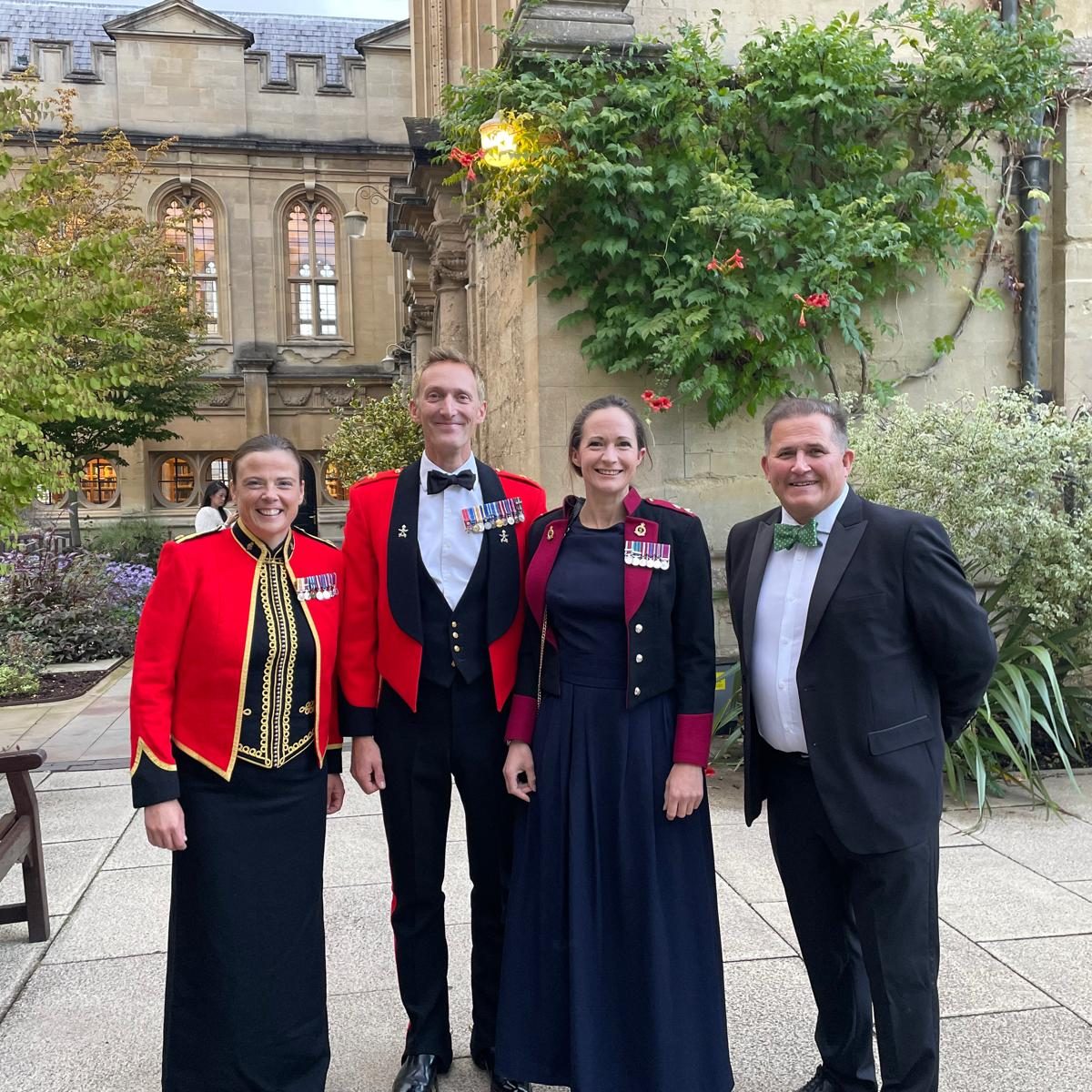
Supporting a defence medical preparedness event at Oxford University. True national resilience is a whole-of-society endeavour encompassing the services, agencies, academia and the community.
Resilience is no longer someone else's responsibility
For generations, resilience was often associated with emergency services, government departments, the military or specialist risk functions. Those capabilities remain essential, but the nature of modern risk means that no single institution can carry the responsibility alone.
The UK Government's Resilience Framework established a clear principle: resilience must be a whole-of-society endeavour, supported by a shared understanding of risk and greater emphasis on prevention and preparation. The subsequent Resilience Action Plan has continued that direction, recognising the increasingly interconnected nature of the risks facing the country. That interconnectedness matters.
Energy depends on technology, technology depends on infrastructure, businesses depend on supply chains and public services depend on people, data and digital systems. Defence depends upon industry, logistics, infrastructure and innovation. Communities depend upon the effective functioning of institutions and essential services. A disruption that begins in one part of the system can therefore have consequences far beyond its original point of impact.
National resilience is consequently not something that can be built in organisational silos, it requires leaders who can see the system rather than simply their part of it.
Defence is one part of a much bigger resilience story
The scale of current investment in Defence illustrates the importance being placed on national capability.
The Government's 2026 Defence Investment Plan commits £298 billion over four years, with investment intended to strengthen readiness, modernise capability, accelerate transformation and reinforce the UK's defence industrial base. That investment is significant. But the underlying lesson extends beyond defence; modern capability is not created by technology or funding alone. It is created when people, systems, infrastructure, industry and leadership come together effectively.
The same principle applies across the wider resilience landscape. The UK's National Security Strategy 2025 places national security within a much broader context, connecting security with economic resilience, critical national infrastructure, technology, supply chains and societal resilience. This is an important shift in perspective; defence protects the nation, but national resilience is larger than defence. It is the capacity of the country - its institutions, organisations, infrastructure, economy and communities - to continue functioning, adapting and recovering when challenged. And every one of those systems depends upon people.
The technology paradox
Technology is becoming one of the most powerful tools available to strengthen resilience.
Artificial intelligence can process information at a scale and speed beyond human capability. Advanced analytics can help identify patterns and emerging risks. Automation can improve efficiency. Digital systems can connect people and information across organisational boundaries. The opportunities are enormous, but technology also creates new dependencies, vulnerabilities and questions of accountability. This is particularly significant as AI moves rapidly from experimentation into operational environments.
The UK Government's AI Opportunities Action Plan identified AI adoption as an important driver of economic growth, productivity and public-service transformation, while subsequent progress reporting has highlighted the movement from strategy towards implementation across government.
At the same time, the National Security Strategy identifies AI and other frontier technologies as important to the UK's future security and strategic capability. This creates what might be described as the technology paradox of resilience; the technologies that make organisations more capable can also make them more dependent on complex systems. The answer however is not to slow technological progress, it is to develop the leadership capability required to harness it responsibly.
The question for leaders is therefore no longer simply, How do we implement AI? It is becoming: How do we lead effectively in an AI-enabled world?
That requires a different kind of leadership conversation. It requires leaders who understand enough about technology to ask intelligent questions, but who also recognise that technology does not replace judgement, purpose, ethics, trust or human accountability. AI can process information, leaders provide context, technology can identify patterns, people determine meaning, automation can increase speed, and human judgement determines how that speed should be used.
The future of resilience will depend on how effectively we bring those capabilities together.
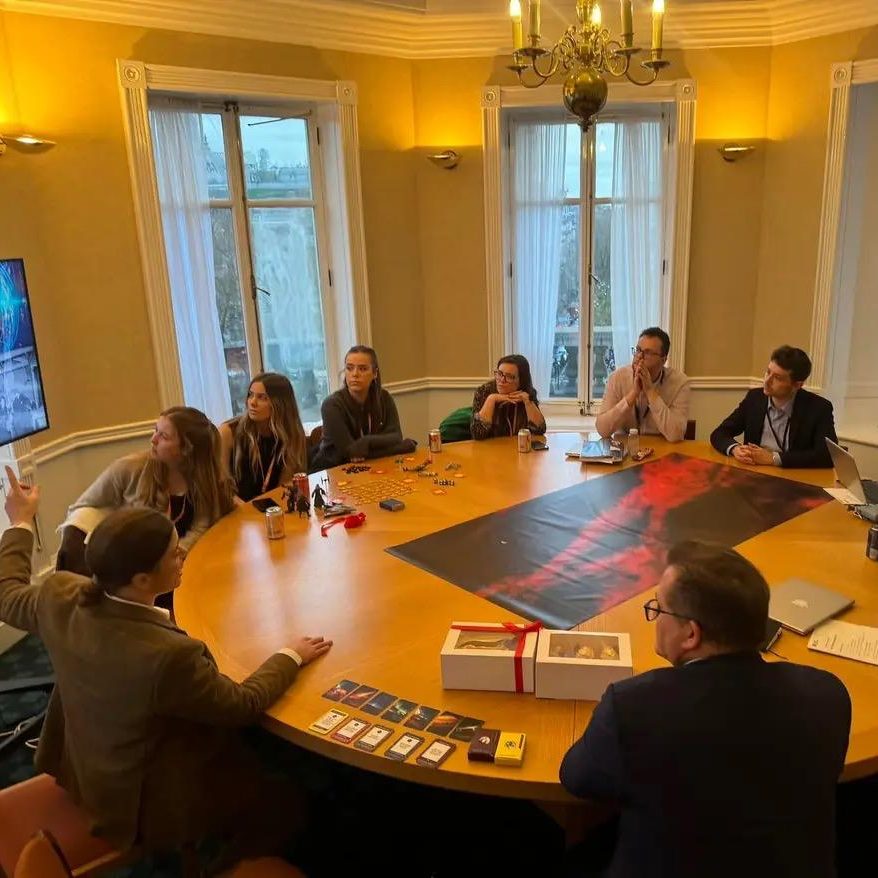
Proud to support UK national resilience and empower emerging talent at the heart of UK parliament in Whitehall through the Strategic Orbits Exercise.
Human capability is part of our critical infrastructure
When we talk about national infrastructure, we naturally think about physical and digital assets: energy networks, transport systems, communications, data centres, water supplies and other essential services. But there is another form of infrastructure that is less visible and arguably just as important: human capability.
Every system ultimately depends upon people who can make decisions, solve problems, collaborate, adapt and respond when circumstances move beyond the assumptions on which a plan was built. The Government's Organisational Resilience Guidance describes resilience in terms of maintaining intended outcomes through uncertainty, disruption and change, with an emphasis on foresight, preparation, adaptation, learning and recovery.
These are not simply operational processes, they are human behaviours and they are profoundly influenced by leadership.
A resilient organisation is not one that never experiences disruption. It is one that has developed the capacity to respond intelligently when disruption inevitably occurs. That requires leaders who can create clarity without pretending to have certainty. Leaders who can make decisions when information is incomplete. Leaders who can encourage challenge without creating paralysis. Leaders who can move quickly without abandoning judgement. And leaders who can turn experience into organisational learning. In other words, resilience requires leaders who are capable of operating in complexity.
The leadership multiplier
This is where the conversation about leadership needs to evolve. Leadership development is sometimes treated as a supporting activity: important for individual progression, employee engagement or succession planning. In an increasingly uncertain environment, that view is too narrow, leadership capability is becoming an organisational and strategic capability. The quality of leadership influences how quickly an organisation adapts, how effectively it collaborates, how willing people are to innovate, how intelligently it manages risk and how successfully it translates strategy into action, that makes leadership a multiplier. Investment creates potential, technology creates capability, infrastructure creates capacity, strategy creates direction. But leadership determines what an organisation does with all of them.
This is particularly important when organisations are undergoing transformation. Transformation is rarely difficult because people cannot understand that change is happening. It is difficult because change disrupts established behaviours, identities, systems and assumptions. People need to understand where they are going, why the destination matters and how they can contribute to reaching it. They need leaders who can create confidence without creating complacency. They need permission to challenge, accountability, trust and to believe that the organisation is capable of adapting. This is where leadership becomes the human infrastructure of transformation.
From organisational resilience to national resilience
The relationship is ultimately straightforward: resilient people contribute to resilient teams, resilient teams contribute to resilient organisations, resilient organisations strengthen resilient sectors, communities and systems and resilient systems contribute to national resilience. The implication is significant: building national resilience is not simply about creating stronger institutions at the centre. It is also about strengthening the leadership capability distributed throughout the system. It is about developing leaders who can work beyond organisational boundaries, understand interdependencies and build relationships before they are needed, creating cultures in which people can identify risks early, challenge assumptions and contribute their expertise, developing the confidence and capability to act when circumstances are uncertain and it is about recognising that resilience is not an event. It is a capability that must be built every day.
Resilience requires a different model of leadership
The leader of the future cannot rely solely on hierarchy, expertise or positional authority. Complex environments require leaders who can create conditions in which others can perform. That means moving from control towards intelligent empowerment, from information ownership towards information sharing, from protecting established thinking towards constructive challenge, from reacting to disruption towards anticipating it and from viewing people as resources towards recognising them as the source of organisational adaptability.
This does not mean that hierarchy, expertise or control become irrelevant. On the contrary; in critical environments, clarity of authority and accountability remain essential. It means understanding when to lead through direction and when to lead through connection, collaboration and distributed decision-making. The resilient leader knows the difference.
The opportunity for organisations
There is a broader opportunity here for organisations across the UK. National resilience may sound like a government-level concept, but its foundations are built within individual organisations every day. Every organisation that develops adaptable leaders, builds high-performing teams, strengthens its culture, improves its ability to learn and embraces responsible innovation is contributing to a more resilient economy and society. This is why leadership development should not sit at the margins of organisational strategy. It should sit alongside transformation, technology, risk, performance and growth. Because when the environment becomes more complex, the quality of leadership becomes increasingly consequential.
The TLA perspective
At The Leadership Alchemist Limited, we believe the next generation of leadership development must respond to this reality. Our focus is not simply on developing better individual leaders: it is on developing leaders who can transform organisations, unlock human potential and strengthen the resilience of the systems in which they operate.
That means connecting leadership with organisational transformation. Connecting human potential with operational performance, technology with responsible human judgement and individual capability with the wider resilience of organisations, sectors and society.
Our proposition is therefore:
Developing leaders who can transform organisations, unlock human potential and build the resilience required to thrive in an increasingly complex, AI-enabled world.
This is a proposition that speaks across Defence, government, critical national infrastructure, business and technology because the challenges may differ between sectors, but the underlying leadership requirement is increasingly shared.
The future of resilience is human
National resilience is not something we simply possess. It is something we continually build and leadership is one of the most important capabilities through which we build it.
Resilience remains fundamentally human, and leadership is the multiplier.
Stay safe, and add value. \
The Leadership Alchemist
References
- Cabinet Office — National Risk Register 2026
- Cabinet Office — UK Government Resilience Framework
- Cabinet Office — UK Government Resilience Action Plan: 2026 Implementation Report
- HM Government — National Security Strategy 2025
- Ministry of Defence / HM Treasury — Defence Investment Plan 2026
- Department for Science, Innovation and Technology — AI Opportunities Action Plan
- Cabinet Office — Organisational Resilience Guidance