Friday 4th September 26
When Leadership Feels Like Too Much: Understanding Overwhelm and Compression
By The Leadership Alchemist, a performance optimisation expert who believes in ethical intelligence, practical productivity, and the responsible acceleration of human potential.
There is a particular kind of pressure that many leaders know intimately: You wake up already thinking about the day ahead.
Before you've even properly started, there are emails waiting. A decision needs to be made. Someone wants an answer. A conversation has been pushed back twice and now needs to happen. Two priorities that both seemed important yesterday are suddenly competing for your attention.
You move from one thing to the next. You solve a problem. Then another one appears.
Someone asks, "Have you got a minute?" — and you already know that you haven't, but you say yes anyway.
By the end of the day, you've been busy almost every minute.
And yet, somehow, it doesn't feel as though you've moved forward.
There is a particular exhaustion in that.
It isn't necessarily physical tiredness. It's the feeling that there is no longer enough room inside your working day - or inside your head - to think properly.
We often call this overwhelm.
But I think sometimes something deeper is happening.
I call it compression.

At a recent community of practice event, where we took time away from the daily compression to focus on the future.
When Pressure Starts to Take Up All the Space
Think about what happens when something is compressed; space is reduced. Everything becomes closer together. There is less room for movement, less room for expansion, less room to breathe.
Leadership can feel like that too.
Over time, demands, expectations, responsibility and complexity can become concentrated into an increasingly narrow space.
You still have the same intelligence, the same experience, the same leadership capability. But you have less room in which to use it, and that changes things.
A decision that you would normally make quite easily suddenly feels complicated. A relatively small issue occupies far more mental space than it deserves. A conversation that you might once have approached with curiosity now feels like another thing you simply need to get through.
You notice yourself becoming more reactive. You have less patience. You find yourself thinking about work when you're supposed to be somewhere else. You tell yourself that it would be quicker to do something yourself rather than delegate it. You start focusing on whatever is most urgent because there simply isn't enough space left to step back and ask what is actually important.
None of this means that you have suddenly become a poor leader.
It may simply mean that your leadership space has become compressed.
Overwhelm Isn't a Leadership Failure
This is an important distinction because we can be remarkably hard on ourselves when we feel overwhelmed.
We tell ourselves we should be more resilient, better organised, more disciplined, more productive.
We look around at other leaders and imagine that they are somehow managing everything effortlessly. So we push harder, start earlier, finish later, make another list, reorganise the diary, download another productivity app. We try to become more efficient at carrying a load that may already be too heavy.
And sometimes those things help, but often they simply allow us to operate inside the compression for a little longer.
The real question isn't always, "How can I fit more into this day?" It might be, "Why has there become so little space in the first place?"
That is a very different question.
The Trap of Doing More
When we feel overwhelmed, doing something can feel reassuring.
There is comfort in action. Answer the email, make the decision, have the meeting, clear the task, deal with the problem, move on to the next one. Action gives us the feeling that we are regaining control. But leadership isn't simply about how much we can get done, it is also about knowing when action is required - and when thinking is what is really required.
Sometimes the most important leadership work happens in the space between the problem appearing and our response to it. That space can be very small, but it matters.
Because when we are under pressure, we tend to move quickly from stimulus to response.
Something happens: we react. Someone asks: we answer. A problem appears: we solve it. A deadline approaches: we accelerate.
The more compressed we become, the less opportunity we give ourselves to pause and ask what is actually going on, and that is where leadership can begin to shift from thoughtful response to constant reaction.
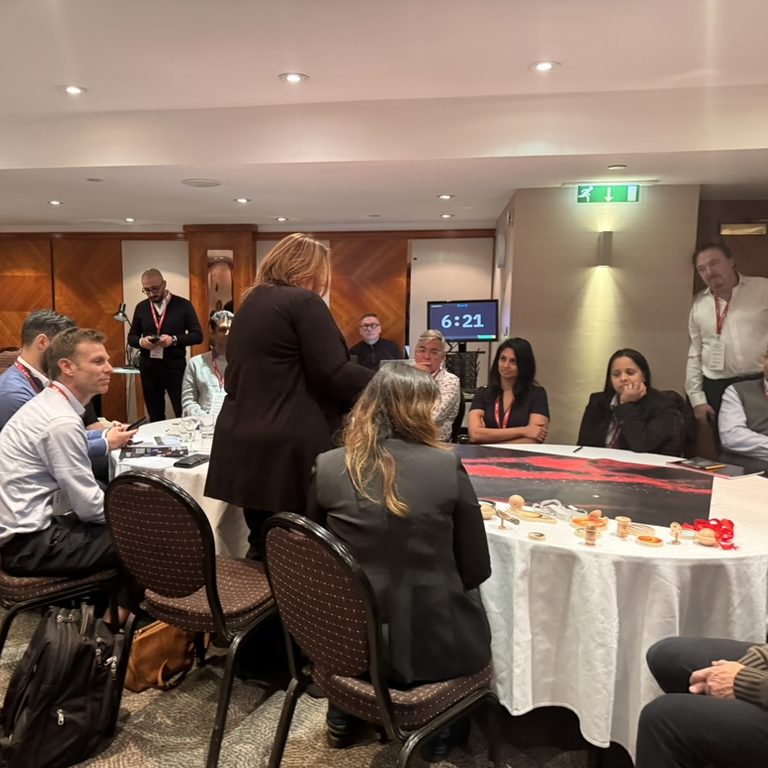
Our Action-learning and serious gaming methods force our participants to narrow their focus to the most urgent and important priorities in order to create clarity faster and enable better decisions.
What Has Your Attention and What Actually Matters?
Imagine a leader arriving at their desk with twenty things competing for attention:
- The loudest problem demands immediate action.
- The person who keeps sending messages feels urgent.
- The deadline feels urgent.
- The difficult conversation feels urgent.
- The unexpected issue that appeared ten minutes ago feels urgent.
By lunchtime, the leader has spent hours responding to whatever shouted the loudest, but attention and importance are not the same thing and that distinction is easy to lose when we are under pressure.
Sometimes the issue occupying the most space in our mind is not the issue that matters most. Sometimes we are carrying something because it is uncomfortable, rather than because it is important. Sometimes we have taken responsibility for something that actually belongs with someone else. Sometimes a decision continues to consume mental energy simply because we haven't made it.
This is where creating space becomes more than a wellbeing exercise; it becomes a leadership practice.
What Happens When We Create Space?
Decompression doesn't necessarily mean taking a month off. It doesn't mean clearing your diary completely or pretending that organisational complexity doesn't exist.
Leadership will always involve pressure.
There will always be competing demands, difficult conversations, unexpected problems and decisions that cannot wait.
The aim isn't to remove pressure, it is to create enough space to meet the pressure and address what matters.
Stay safe, and add value. \
The Leadership Alchemist